


Researchers at the Department of Physics at Chalmers University of Technology may have made a remarkable breakthrough. They have been looking for ways to achieve the theoretical potential of lithium sulphur batteries. EurekAlert reported on April 29, 2019 their lithium battery sponge may achieve five times more density than conventional lithium ion.
Their Lithium Battery Sponge Is a Free-Standing Electrode
Traditional batteries comprise two supporting electrodes, the anode and a cathode with an active substance coating. An electrolyte, usually liquid allows these to exchange ions. Finally, a separator keeps the electrodes physically apart.
However, battery researchers have been examining ways to combine these elements to reduce bulk and weight. This could allow faster charging and greater capacity. In the process, they have merged the cathode and the electrolyte into a liquid they call the ‘catholyte’. However, this modification did not produce intended benefits until Chalmers University of Technology scientists added their breakthrough lithium battery sponge.
The Big Difference a Small Aerogel Wafer Makes
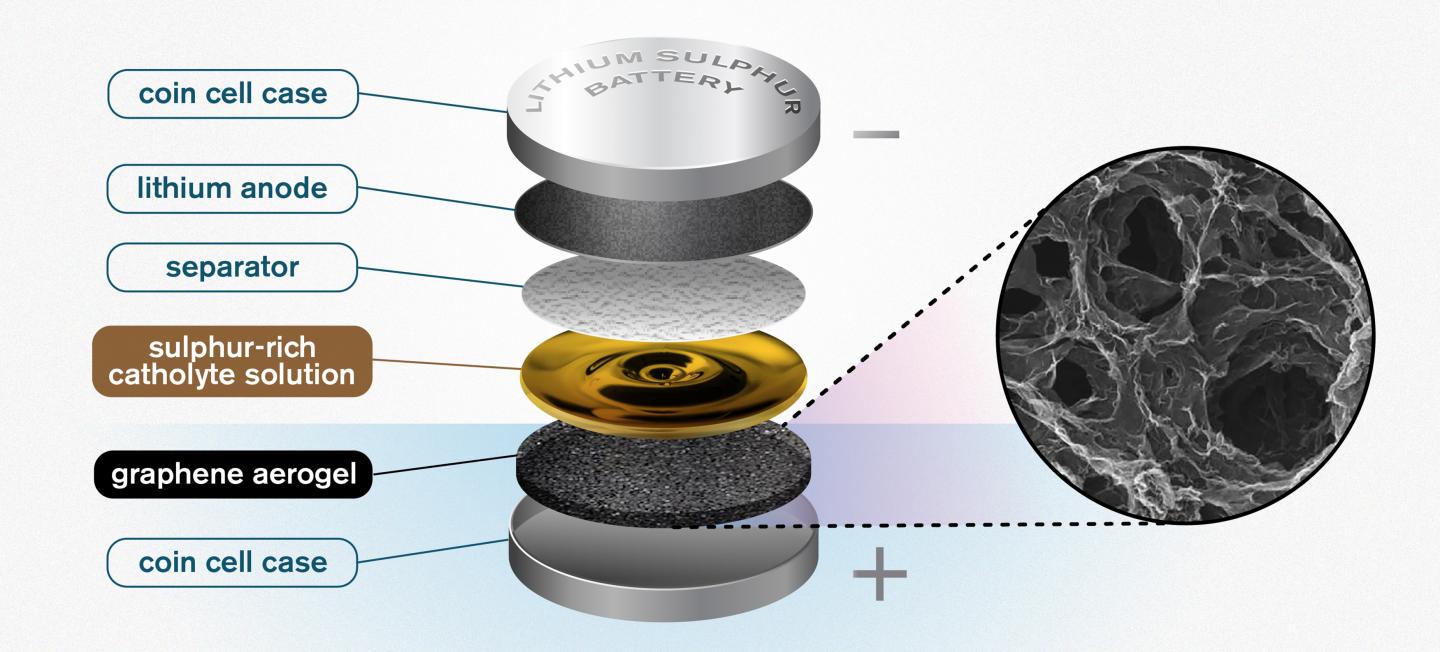
The researchers added the spongey layer between a sulphur-rich catholyte solution and the cell case of a button battery. “You take the graphene aerogel,” explains a researcher. “This is a long thin cylinder, and then you slice it – almost like a salami. Then you take that slice, and compress it to fit into the battery,”
Mama mia … the porous graphene aerogel “soaks up a high amount of the catholyte,” EurekAlert explains. “This gives you high enough sulphur loading to make the catholyte concept worthwhile.” That’s because the sulphur can then cycle back and forth without any loss of potential. Moreover, it is already liquefied in the catholyte solution and therefore cannot dissolve.
The best lithium-ion batteries produce 300 watt-hours per kilogram. However lithium sulphur ones like this could achieve 1000 to 1500 watt-hours thanks to the lithium battery sponge.
Related
What are Lithium-Sulfur Batteries?
Lithium-Sulfur Batteries Tap Transport’s Door
Preview Image: Innovative Uses for Lithium-Sulfur Batteries


