

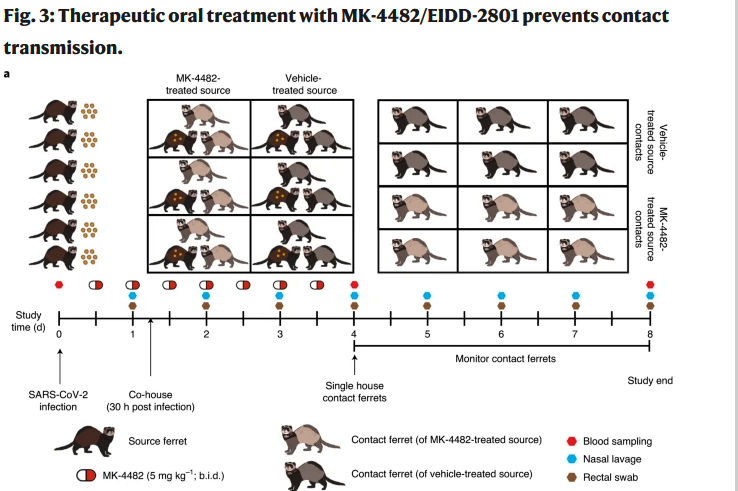
Scientists at Institute for Biomedical Sciences, Georgia State University, Atlanta may have made a long-awaited breakthrough. Because they have tested new anti-viral drug MK-4482 / EIDD-2801 on otters, and found this blocks COVID-19 transmission. Moreover, Enterpreneur.Com suggests this drug, Monulparivir could stop the virus spreading within 24 hours if administered to human patients.
Imagine if Monulparivir Could Stop the Virus in Its Tracks
A team at Emory University in Atlanta developed the antiviral drug to treat flu. But it also holds promise not of preventing COVID as a vaccine, but of preventing spreading as a medication. Therefore this could be incredibly important in the light of naysayers refusing vaccines. And in addition by implication continuing to promote the COVID-19 pandemic.
A report in Nature Microbiology Journal describes how infected ferrets responded to the drug, first by reducing their viral particles. And then by being unable to infect other healthy ferrets, when together in the same enclosure. Drug Innovation Ventures at Emory actually developed Monulparivir to treat the flu, and prevent that virus from making copies of itself. And while this is currently in advanced phase II / III clinical trials, this new opportunity has emerged.
What a Wonderful Bonus If This Works on Humans
If Monulparivir could stop the COVID virus spreading as effectively in humans as in ferrets, it could be a game changer. That’s because patients would be able to take it orally by swallowing, and obtain these three benefits according to Entrepreneur.Com:
1… Hinder or prevent their disease becoming serious
2… Shorten the length and cost of their infectious phase
3… Quickly dampen down local outbreaks and block them
This work appears to be the first emergence of a drug that could effectively block the transmission of SARS-CoV-2. As such, it’s a wonderful opportunity to tackle a terrible disease, and on a scale we might not have thought possible before.
Related
Using Airflow to Reduce Infections in Autos
Difficult Time in US Public Health History
Preview Image: Testing Monulparivir on Ferrets


