South Africa Health Minister Zweli Mkhize announced the AstraZeneca vaccine is on hold in his country on February 7, 2021, pending further advice. Inoculating health workers in the first phase therefore cannot continue, because of the vaccine’s limited efficacy over the local variant. As this variety accounts for 90% of new Covid cases in South Africa, what does this mean for the rest of us?
What Does This Mean for the Rest of the World?
The first round of vaccinations may be more of a parole, than a “get out of jail” card. The highest-rated ones will probably only shield nine out of ten of us according to their trials. There are also unanswered questions about future mutations and variants. Pandemics and plagues in the past caused immense disruptions in the absence of effective vaccines and medications.
New York Times confirmed the news concerning the AstraZeneca vaccine on February 7, 2021. The product did not protect volunteers from mild-to-moderate illness in a small, local clinical trial. The researchers had detected a similar problem with strain B.1.351. This did not protect volunteers from mild-to-moderate illness either.
AstraZeneca Vaccine on Hold in South Africa
However, we don’t know how older people will feature in this scenario yet. The median age in South Africa is 27.6 years. The average age of trial participants was 31 years, and appears to have largely excluded the older demographic most at risk of severe symptoms from the virus.
The researchers at Johannesburg’s University of the Witwatersrand however hope the vaccine will counter more severe cases. They base this on observation of blood samples from volunteers participating in the trial.
Pfizer, Moderna, Novavax, and Johnson & Johnson also report lower efficacy against the South African variant. The AstraZeneca vaccine will remain on hold in South Africa, at least until there is greater certainty about this.
Related
COVID-19 Spread via Contacts and Droplets
Oxford Vaccine Squaring Up To New Variants
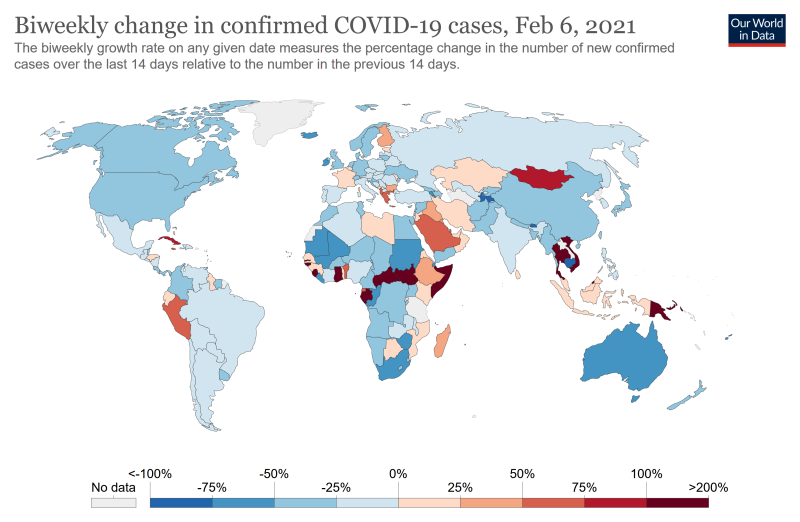
Preview Image: Bi-Weekly Change in Cases