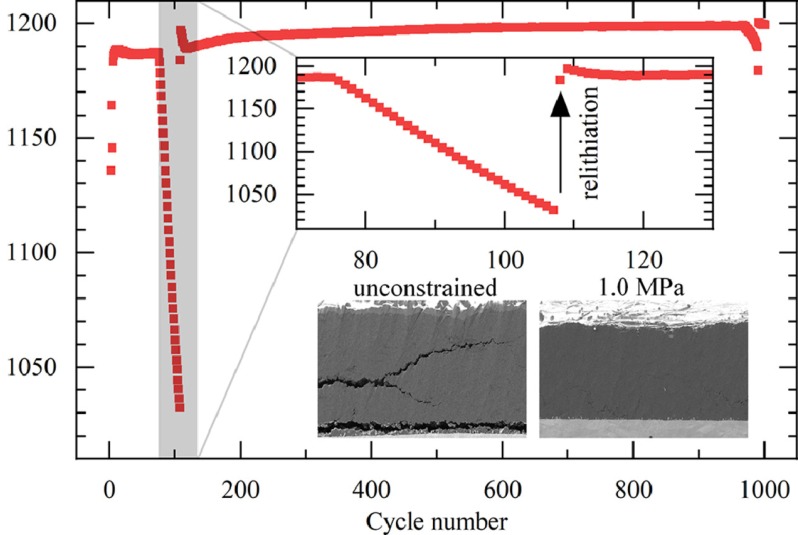
External pressure on lithium-ion batteries is not a dry academic topic. Scientists at Fraunhofer Institute for Silicate Research in Würzburg, Germany, investigated the impact on pouch-type cells. They compared the benefits of allowing space for electrodes to swell during cycling, and concluded this promoted better battery performance.
Using Compression Pads to Manage External Pressure
Compression pads sound like an unimportant detail, but their relevance increases in electric vehicle batteries and bulk energy storage. Consider the cumulative impact of hundreds of lithium-ion pouch cells, all expanding and contracting during charging and discharging.
Some of this expansion may become permanent, leading to increased external pressure on lithium-ion pouch batteries. Strategically-located ‘springy’ compression pads act as cushions relieving the external strain. But that’s not all …
Good contact between internal components is essential for effective battery performance. Compression pads improve component contact, and help maintain this at the optimum level. This in turn promotes more rapid ion movement.
An effective, stable situation like that slows battery degradation too. This is because it mitigates against materials separating from current collectors, and electrodes gradually fracturing with age.
Maintaining Optimum Pressure on Lithium-Ion Batteries
AZO Materials explains how compression pads can help contain eventual, irreversible battery swelling. They cite deep research confirming the importance of retaining optimum external pressure on pouch cells.
Maintaining the right level of outside pressure, they say, positively impacts on battery lifetime storage capacity retention. Out of interest, they mention the optimum pressure on pouch cells is within 20 to 40 kilopascals.
To wrap things up, compression pads help maintain optimum external pressure on lithium-ion pouch batteries. As they contract while they discharge, and then expand again as they recharge.
To broaden this topic, pouch cells require softer compression pads than firmer prismatic cells. While solid-state batteries require very stiff compression.
External pressure on lithium-ion batteries is not a dry academic topic. It is like a living thing evolving steadily, like the rest of the world of batteries we explore in this blog.
More Information
Chemo-Mechanical Stress in Batteries
Your Phone is Bulging – What Now?
Preview Image: External Pressure on Pouch Cells