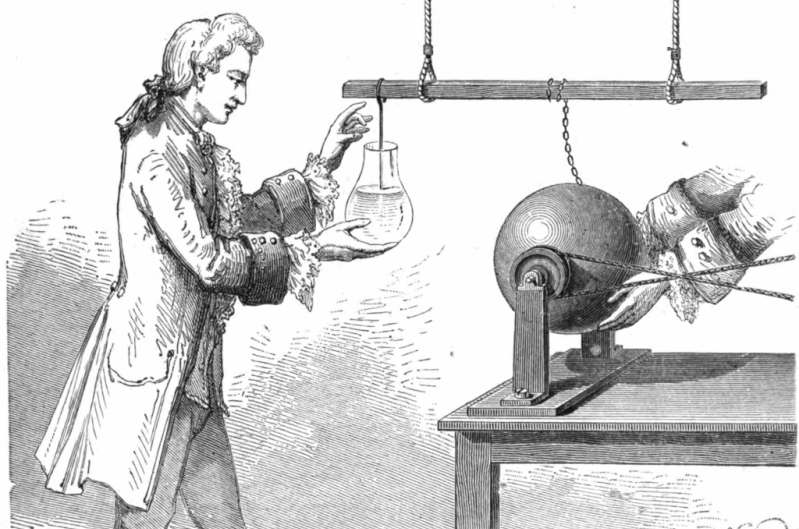
Prussian aristocrat Ewald Georg von Kleist created a ‘Leyden Jar’ on October 17, 1745, that behaved like a capacitor. It was a simple glass affair filled with a liquid, and with an iron nail protruding from it. Dutchman Pieter Van Musschenbroek was independently working on a similar concept. Because communications were so slow, the folk there believed the Van Musschenbroek capacitor was the original invention.
Pieter Van Musschenbroek and His Famous Capacitor
Van Musschenbroek was a deeply religious man, who believed the world around him was an orderly creation so ordained. The task of scientists, in his world was to discover those constant, unchangeable rules. There was nothing new to invent. Humankind had to discover what was already there.
Pieter Van Musschenbroek was professor at several Dutch universities, including Duisburg, Utrecht, and Leiden. His specialisms were astronomy, mathematics, medicine, and philosophy, but most importantly he had a deeply inquiring mind. His early work delved into tension, compression, and the force need to flex a material, but there was more to follow.
Van Musschenbroek’s Special Interest in Electrostatics
The appointment at Leiden brought Van Musschenbroek in touch with a student there, Andreas Cunaeus. They already knew they could generate transient electrical energy with a friction machine. However, as far as they knew nobody knew how to store it.
The world changed forever when Musschenbroek, Cunaeus, and a third collaborator Jean Allamand cobbled together a glass jar, a quantity of water, and an iron nail.
They discovered they could store the electrostatic energy from the friction machine in the nail, in 1746. And then discharge it from the Van Musschenbroek capacitor they created, by touching the outside of the jar with one hand. This was the first such device of which they knew, and they claimed the discovery of this constant, unchangeable rule they found.
More Information
Ewald Georg von Kleist Creates Capacitor