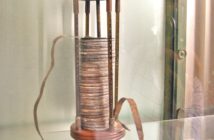
Benjamin Franklin was a pioneer American writer, scientist, statesman, diplomat, printer, publisher and political philosopher. He also played a significant role in the birth of his nation, although his inquiring mind loved tinkering with things. Today, we share Franklin’s early electrical experiment, in the course of which he invented the term ‘battery’ which you should know is our favorite topic.
Franklin’s Early Electrical Experiment with Leyden Jars
Ewald Georg von Kleist was a German priest who invented a jar for storing electricity in 1745. Although to be fair, Dutch scientist Pieter van Musschenbroek who lived in Leiden also independently came to the same conclusion.
The Leyden Jar as it was then, was a simple device which stored an electrical charge from an external source. The design was follows:
- A glass jar with a tapering neck and electrically conductive lining.
- Sufficient water, or another suitable liquid to partly fill the jar.
- An electrically conductive covering on the outside of the glass jar.
- A metal chain connecting the inner foil, to space outside the jar.
Connecting the chain to an electrostatic generator charged it with energy, creating the world’s ‘first capacitor’. However, connecting the chain to the outside foil covering instantly discharged it. Here are some ideas for making your own, but please do be careful and ask an adult if you need advice!
What Benjamin Franklin’s Inquiring Mind Made of This
Well first of all, Franklin had already conducted a number of experiments which revolutionized people’s understanding of electricity. So naturally his reaction to his first Leyden jar was ‘what else can I do with this thing’? So he experimented with linking several Leyden jars together in series, and found this increased the total charge. This was revolutionary!
Franklin assembled several jars in an open box. Together, these resembled an artillery battery of many military canons in his mind. So he called his Leyden Jar collection a ‘battery’, and that’s where the name from in case you wondered.
The moral of our story is that Franklin, von Kleist, and van Musschenbroek were not qualified electrical engineers. They were curious individuals with open minds ahead of their time. They could see beyond the now, to a future then. Therefore, we could say progress depends on people who do not accept things the way they find them.
Breaking News
Lithium-Ion Battery Degradation Fathomed
Recycling Lithium-Ion Batteries With CO2