We say ‘creates, and not ‘invents’ because energy history is uncertain here. Suffice to say Pomeranian Ewald Georg von Kleist, and Dutchman Pieter van Musschenbroek invented the first capacitor almost simultaneously. Today we consider who von Kleist was, and his contribution to energy storage science.
Ewald Georg von Kleist Was a Polish Aristocrat
Von Kleist was a member of a noble Prussian family, and this produced many senior military officers. This wealthy background enabled him to study legal principles in Leipzig Germany, and Leyden in the Netherlands.
The young man became a leading personality that saw him elevated to senior priest at a Pomeranian cathedral. Later he became president of the Royal Court of Justice in Koszalin in modern Poland. In case your head is spinning, national borders were flexible back then.
Was this the Birth of the First Capacitor?
Ewald Georg von Kleist developed an interest in electricity while he was a student at Leyden. On October 17, 1745 he invented a capacitor, which was essentially a glass jar containing a liquid such as mercury.
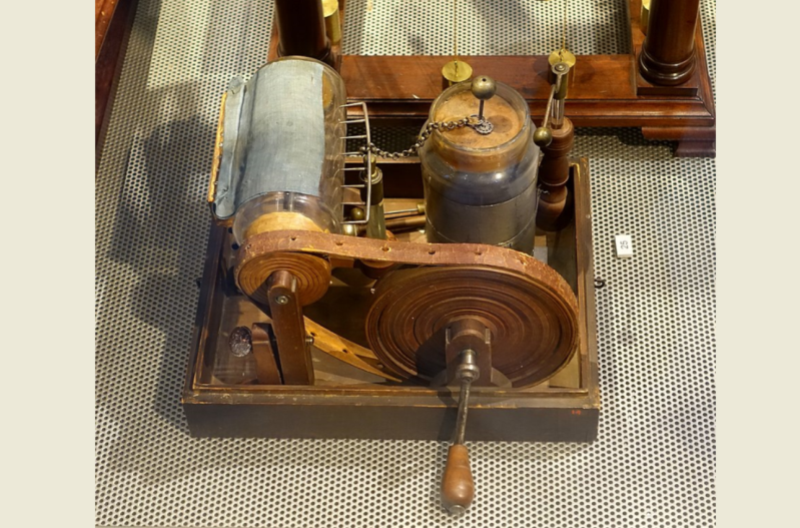
He inserted an iron nail into the liquid and electrified it with his ‘frictional machine’. This was a gadget that generated static electricity. But more importantly van Kleist discovered his ‘capacitor’ retained the current, and he could even apparently ‘ignite spirits’ with the nail.
Von Kleist published his work openly, but news only reached Leyden after van Musschenbroek made a similar discovery. We can’t say whether the two scientists ever met or even communicated. If they had secrets they never shared, then these were lost in history.
Early scientists named capacitors ‘condensers’, and we still come across this term today. Half a century later, Alessandro Volta invented a pile battery he called a ‘condensatore’. So capacitors actually predated batteries, although batteries assumed center stage for centuries.
More Information
What is a (Modern) Capacitor in Simple Terms?