Our previous three posts reach the inescapable conclusion that neither batteries, nor capacitors meet our future portable storage needs completely. Batteries store far greater quantities of energy, and can deliver it in a dependable stream. While capacitors concentrate their energy for a single event like a camera flash. Our thoughts turn towards hybrid supercapacitors to merge these two opportunities.
Why the Swing Towards Hybrid Supercapacitors?
Batteries are reaching the end of the road in terms of their core technology. They are doing a sterling job of what they do. But they also have a limited lifespan, and most depend on scarce mineral resources. Capacitors, on the other hand perform better across these dimensions, but they are simply not powerful enough.
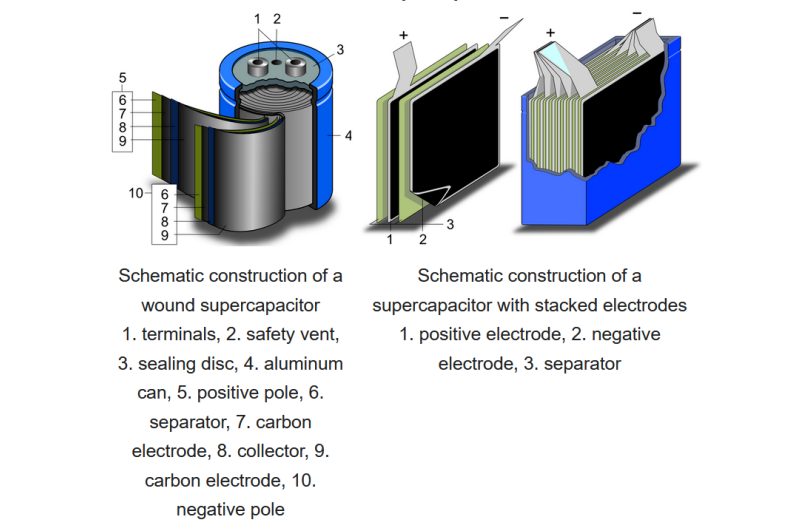
Supercapacitors, also known as ultracapacitors have some of the best attributes of those two storage worlds.
- Super capacitors have greater capacitance but lower voltage limits
- They store as much as 100 times more energy per unit of volume or mass
- They can accept and deliver charges far faster than conventional batteries
- They can also tolerate many more charges and recharges than batteries
The secret sauce behind this success includes storing more energy on larger surface areas. Plus the fact they store this potential on the surface of their plates, as opposed to chemically.
Current Applications for Supercapacitors
The shift towards hybrid supercapacitors takes advantage of applications requiring repetitive, rapid charging and recharging. These include regenerative braking, short-term energy storage, and burst-mode power delivery to reduce standby consumption. Here’s a summary of how batteries, capacitors, and supercapacitors stack up:
- Standard electrolytic capacitors have unlimited charge / discharge cycles, deliver up to 500 volts, and respond well to lower frequency, alternating current.
- Supercapacitors can store up to 100 times more energy, but are direct current-focussed and do not support alternating currents.
- Supercapacitors feature higher peak currents than batteries, with lower costs per cycle and no danger of overcharging. They also use less-toxic materials.
- Batteries, on the other hand cost less, and deliver stable voltage during discharge. However, they require electronic controls, and there’s a spark hazard.
It seems probable this current state of affairs will remain intact until we find a more viable alternative. The need for one is increasingly urgent, as more extreme weather dogs gradual global warming.
More Information
Let’s Compare Batteries and Capacitors