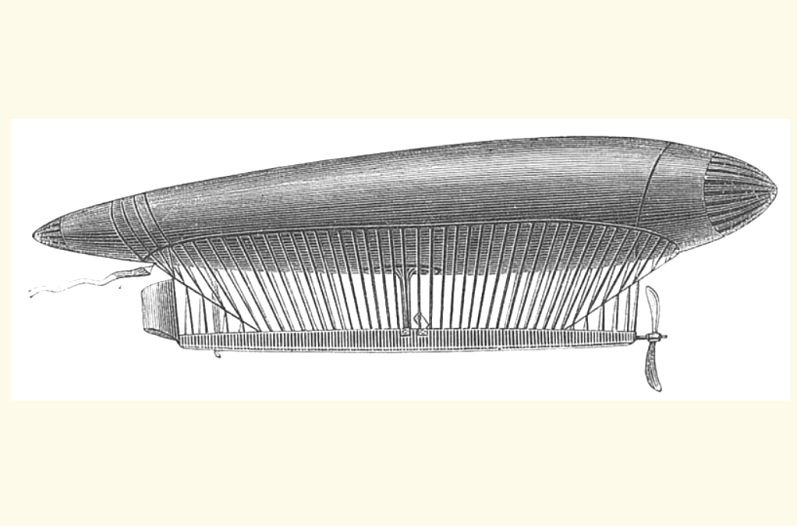
News reports follow what’s hot in editors’ minds, and batteries were more the stuff of scientists back in 1884. But a balloon flight over Paris, now that was sensational. Especially as they launched it from a military base when France was at war with China. Hence the fact the vehicle was a flow battery power airship was of lesser interest.
The Flow Battery Power Airship Was Huge
The flow battery power airship could have dwarfed one of NASA’s best efforts. The giant, hydrogen-filled lifting balloon was 170 feet long, and contained 66,000 cubic feet of hydrogen gas. An electric motor drove a 23-foot-diameter, four-blade wooden tractor propeller. Fortunately, the operator was able to incline this upward for a softer landing
But, the cherry on the top was a 959-pound-weight, zinc-chlorine flow battery more than able to sustain a 23-minute flight. From this we can probably safely assume this innovation performed better, than contemporary lead-acid batteries in terms of capacity / weight.
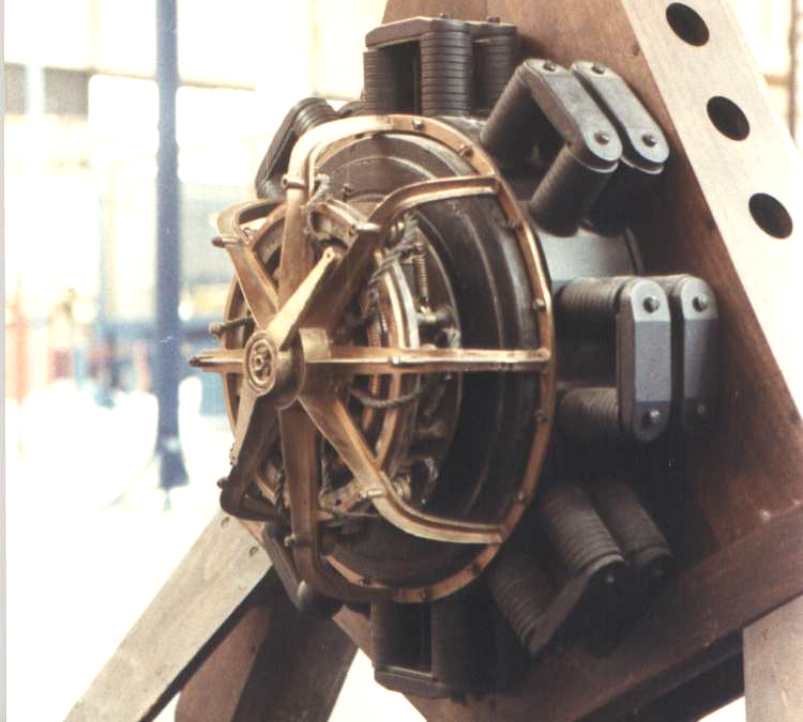
However, innovators Charles Renard and Arthur Krebs could not patent their design. This was because their compatriot Gaston Tissandier and two pals attempted something similar the previous year. His proprietary flow battery worked a treat, and he was able to ascend and make meteorological observations.
But the Battery Power Information is Scant
History is silent concerning the details of the zinc-chlorine flow battery, powering the giant airship. Although Blimp-Info suggests it was similar to the one Gaston Tissandier used the previous year. Whatever the case, it drove an electric motor producing 7.5 horsepower. But Renard and Krebs later upped this to 8.5 horsepower.
They deserve their place in history because their airship made a horizontal journey, as opposed to simply rising high up into the sky like Tissandier. And as a result, the flow battery power airship La France covered a distance of 5 miles in 23 minutes, and returned to earth smoothly at the point where it started.
More Information
What Made the Doyle Flow Battery Unique?