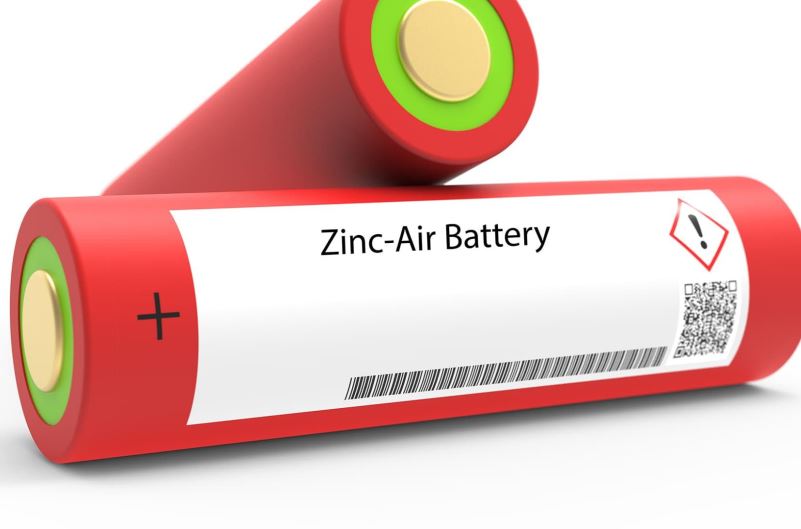
Rechargeable zinc and air batteries could outwit lithium, if we could improve the quality of their electrodes, and extend their operating life. That’s because zinc is the fourth-commonest metal after iron, aluminum, and copper, and air is all around us. Zinc-air batteries have powered a generation of hearing aids, but that’s not the end of their road.
How Zinc and Air Combine to Form a Battery
Zinc-air batteries operate though two redox reactions, and potentially deliver three-times the density of lithium-ion. Although their relatively poor performance at their air anode has been holding them back.
Scientists at Edith Cowan University in Western Australia (ECU) recently claimed to have found a way to remedy this deficiency. We decided to revisit this topic and see what more we could learn.
Professor Muhammad Rizwan Azhar led the project under an overall program to advance sustainable battery systems. Although his university played a role in the development of lithium-ion batteries, it is now seeking a less expensive, safer zinc-ion alternative.
“With the emergence of next-generation long-range vehicles and electric aircraft in the market, there is an increasing need for safer, more cost-effective, and high-performance battery systems,” he believes. “A chemistry that can surpass the capabilities of lithium-ion batteries.”
ECU’s Solution For More Viable Zinc Storage
The limited power and short operating life of zinc and air batteries could become a thing of the past, if the ECU prof has his way. His team of electro-chemical engineers is pushing ahead with their ideas to improve air anode performance.
Their novel method uses a combination of new materials such as carbon, cheaper iron, and cobalt based minerals. “The new design has been so efficient it suppressed the internal resistance of batteries,” the delighted prof says.
“And their voltage was close to the theoretical voltage which resulted in a high peak power density and ultra-long stability. This breakthrough contributes significantly to building a sustainable society, reducing our reliance on fossil fuels, and mitigating environmental impacts too.”
More Information
Zinc-Based Batteries Do Have a Future
Aqueous Rechargeable Zn-Ion Battery Stability