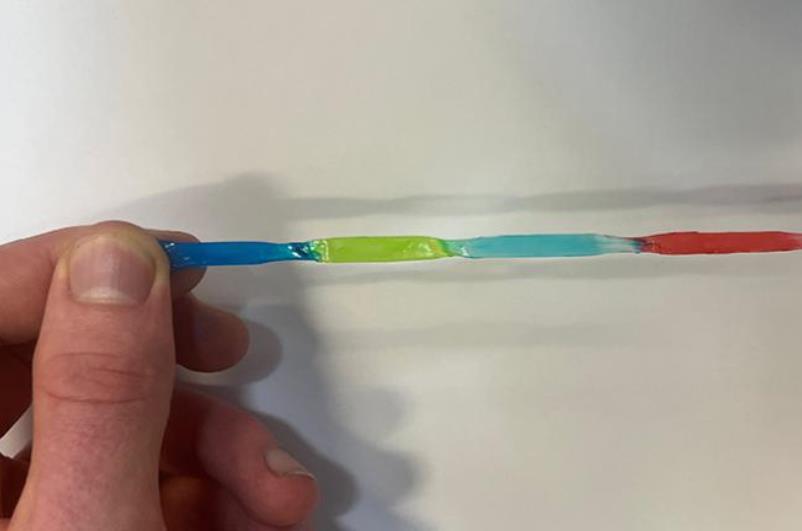
Eels have long, continuous fins along their backs, that stretch from their necks all the way to their tails. They swim by using these fins to generate waves traveling the length of their bodies. If they reverse the direction of the waves, then they can swim backwards. Scientists at University of Cambridge, England developed soft stretchy jelly batteries from inspiration they gained from eels.
So The Soft Stretchy Jelly Batteries Behave Like Eels?
No not exactly, although there is a slight resemblance. Eels, and other electric fish stun their prey using modified muscle cells called electrocytes. Wikipedia explains how these nerves generate electric fields that knock their prey out. We could compare this arrangement to a voltaic pile battery, but more about that in our next post.
Getting back to Cambridge University England, the scientists developed a layered structure able to deliver an electric current. They describe this as being a bit like ‘sticky lego’, although we were unable to fathom why they say so. So setting this paradigm aside, what exactly did the team achieve?
Well, their soft stretchy jelly batteries can expand to ten times their length without affecting their conductivity, or ability to transmit electricity. And moreover, the university news item (see link below) says this is the first time that anybody achieved this with a single material.
How The Stretchable Invention Conducts Electricity
The Naked Scientists website believes this invention has applications in wearable devices. However, to us more importantly, surgeons could implant the invention in human brains to treat conditions like epilepsy or depression.
The Cambridge University scientists developed their soft stretchy jelly batteries from hydrogels. These are three-dimensional networks of polymers containing 60% water. ‘Reversible on-off interactions’ hold these materials together, by controlling the jelly’s mechanical properties.
The result is a material capable of closely imitating the flexible nature of human tissue. This in turn makes the product suitable for bio-electronics and soft robotics. However, the material is also surprisingly tough and able to self-heal, even conceivably, inside a human body.
More Information
Plastic Batteries From Conductive Polymers
Could Electric Eels Give Batteries a Few Tips?
Preview Image: Soft, Stretchy Jelly Battery