There are so many different rechargeable and single use batteries on the market, it’s not that difficult to become confused. Some of them are distinctly different, while other batteries simply have different, eye catching labels. We wrote this post to explain the common denominators of all batteries. Your purchasing decisions should become simpler, when you know that all batteries have these things in common.
All Batteries Have a Common Purpose
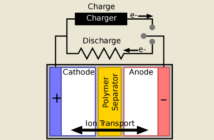
The purpose of every battery is to store electro-chemical energy, and to release this as electrical power on demand. Every battery, no matter what is on the label, has the following four basic parts:
- A pair of electrodes with terminals reaching outside to connect with the energy world.
- Liquid or solid electrolyte solution managing energy flow between these two electrodes.
- Physical separator preventing the electrodes touching, and short-circuiting this energy.
- A hard battery case, or flexible pouch that protects these parts, and keeps them in place.
The composition of the electrodes, and the liquid or solid electrolyte, govern the amount of power a battery stores in terms of volts. It also regulates the rate that a battery releases its energy, in terms of watt or kilowatt hours.
A Working Example of a Typical Battery
All batteries have those four basic components inside them, although their chemical properties vary. Let’s consider a simple example of a voltaic (electrochemical) cell with electrodes of zinc and copper respectively. As an aside this was the the formula for the world’s first ever battery, invented by Alessandro Volta in 1799.
The zinc electrode in our example has a good natural supply of negative electrons. While the copper electrode is well-endowed with positive particles. This difference in potential causes electricity to flow, when the terminals contact through an external circuit.
All batteries have these four basic parts inside their cases. But the composition of the actual ones vary, depending on the output required for users. Decide on your personal requirements first, then go shopping in confidence for the battery type you need.
More Information
Call to Boost Battery Storage at COP 29