Argonne National Laboratory is a leading research center, operating under the umbrella of the U.S Department of Energy. Physics World, official mouthpiece of the Institute of Physics, published a summary of the main thrusts in battery research at Argonne. We decided to curate the information here, and add a few of our own thoughts.
Argonne’s Main Thrusts in Battery Research
Lead-acid batteries are high on the list of Argonne’s interests, on account of their low cost, solid reliability, non-flammable nature, and easy recycling. The National Laboratory is seeking ways to improve their cycle life though, so they have a role in grid support too.
However, Argonne seems less enthusiastic about lithium-ion chemistry, in terms of its unstable supply chain. As Physics World explains, the sticking points are dependency on cobalt from Democratic Republic of Congo, and China’s control over lithium metal.
Therefore, the question arises, where else should Argonne National Laboratory seek for ‘the next lithium-ion battery’. Physics World suggests that sodium-based batteries that use neither cobalt nor lithium could become a long-term answer.
Sodium-Sulfur Batteries Without Lithium Or Cobalt
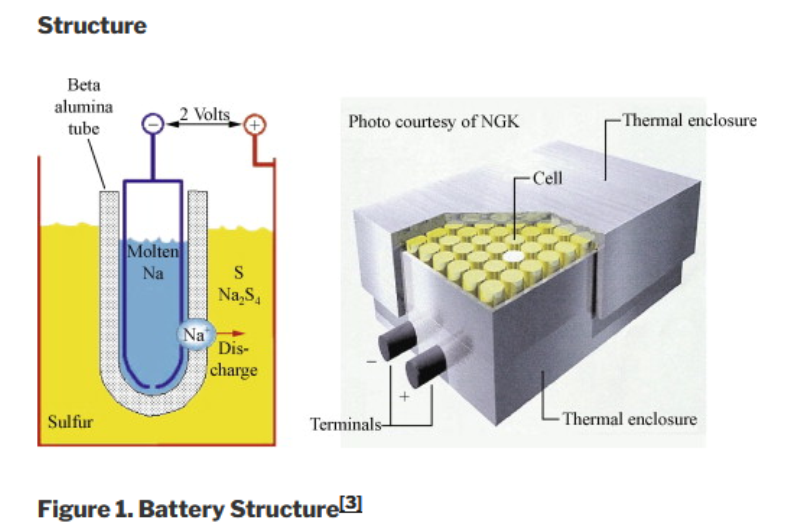
Sodium sulfur batteries are one possibility because, they use liquid sodium and liquid sulfur electrodes. Their inexpensive non-toxic materials deliver energy equivalent to lithium-ion, and that’s a great start.
However, sodium-sulfur batteries are not among the high-profile thrusts in battery research at Argonne, due to their high operating temperature ranging between 300 and 350 °C. Although they might have applications in road transport, at some point in future.
For these reasons inexpensive, high density molten sodium–sulfur batteries have not achieved wide-scale success. However, they may become more feasible for large-scale installations later, because their relative heat decreases with size.
Argonne National Laboratory thus appears to be correct in searching for lithium-ion alternatives elsewhere. Although, as we now know, few things are cast in concrete in our intriguing world of batteries.
More Information
Sodium Sulfur Flower Power? What Next!
Sulfur Selenium Battery Breakthrough at NASA