Three factors discourage vehicle owners from migrating across to electric vehicles. These deterrents are driving range, time to recharge batteries, and how many years the batteries will last. Chinese battery maker CATL wants to tackle these challenges simultaneously, with electric vehicle battery swaps that complete within 100 seconds.
Unpacking CATL’s Fast Electric Vehicle Battery Swaps
Clearly, a scheme such as CATL’s is only practical on a large scale, if battery dimensions are similar. This is not currently the case, although CATL has plans to rectify that.
However, it has to start somewhere. In this instance CATL’s next move was at the Choco-Swap ecosystem conference held recently in the coastal city of Xiamen, China. Almost 100 ‘partners’ were present to mark what could be a historic step forward, according to a CATL press release we link to below.
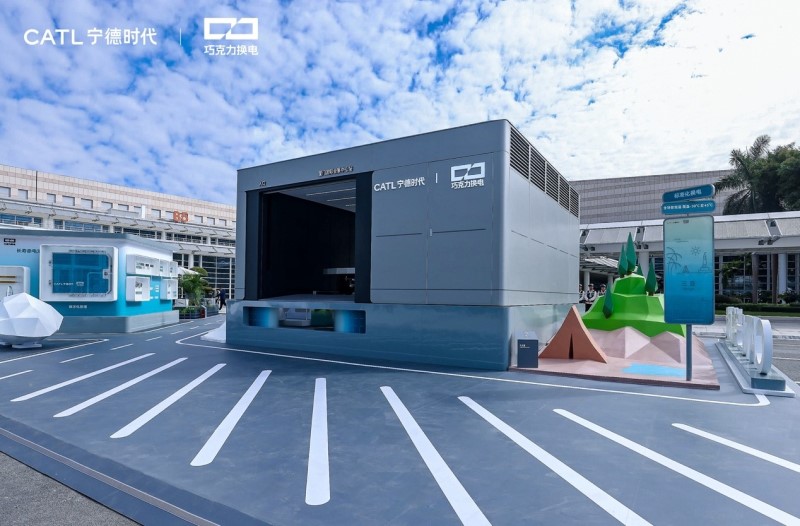
Those present at the Choco-Swap ecosystem conference were able to view two standardized battery models, namely #20 and #25. The Choco-SEB swapping stations that CATL envisages will have 14 to 30 battery-changing modules. These will be able to complete electric vehicle battery swaps in less that two minutes.
We understand from the press release that six electric auto brands have already joined CATL’s battery swap syndicate. And that they have undertaken to mass produce 10 electric cars able to accommodate Choco-SEB swappable batteries. CATL already has plans to roll out 30,000 battery swap stations across China.
More About CATL’s Standardized Battery Models
CATL’s two standardized battery models, #20 and #25, are flexible within their set dimensions. Customers will have a choice between lithium ion phosphate (LFP), and lithium nickel manganese cobalt oxide (NMC) chemistries, for example:
- The #20 LFP version offers 42 kWh capacity and a range of 250 miles.
- The #20 NMC version offers 52 kWh capacity and a range of 315 miles.
- The #25 LFP version offers 56 kWh capacity and a range of 315 miles.
- The #25 NMC version offers 70 kWh capacity and a range of 375 miles.
CATL predicts that a standardized approach will “significantly reduce the development costs of battery swappable vehicles”. And moreover shorten new vehicle development cycles by more than six months, breaking the “quality, performance, and cost trilemma”.
More Information
Fifty Million Battery Swaps And Counting
Battery Swap Stations Support Taiwan Grid