A team from several Asian universities recently took a fresh look at the diminished performance of batteries at low temperatures. This challenge faces electric vehicle owners every time winter arrives. The researchers were aware of the limitations of electrical vehicle battery heaters. So they decided to investigate a better low temperature battery instead.
Why We Need Better Low Temperature EV Batteries
We are ‘closing the stable door after the horse has bolted’ with battery pre-warming. That’s because the low temperature issue is a material, not a design problem. You see, everything contracts as it cools, and the molecules slow down. This thermal contraction is behind poor cold battery performance.
The research report, that we link to below. acknowledges that metal-ion batteries have poor low-temperature electrochemical kinetic performance. This, they say, is limiting the use of lithium-ion batteries in electric vehicles.
Therefore, the team proposes moving away from high-expansion materials, to those with negative-thermal-expansion properties. This is because these materials could enable better low-temperature performance. And this could lead, in turn, to a new strategy for a better low temperature battery.
Proposal For Negative Thermal Expansion Battery Material
The researchers now understood that their problem lay in the slowed diffusion rate of lithium ions at low temperature. Therefore, they concluded, the solution lay in making electrodes from materials with negative thermal expansion properties instead.
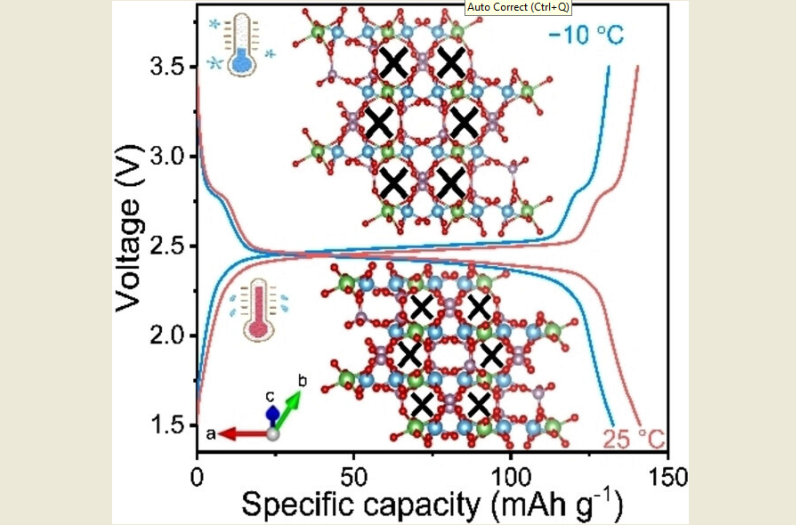
They decided to test lithium titanate phosphate as a possible alternative material. And they used this compound to demonstrate that electrodes with negative thermal properties, can perform well at low temperatures too.
Spectrometric and electron microscopic analyses, and computer calculations, revealed that the vibrational modes of the atoms changed at low temperatures. And as a result, their distances from each other increased, expanding the cavities and facilitating the transport of lithium ions.
Coating the lithium titanate phosphate with carbon delivered good electrochemical performance, high capacity and high discharge rates at −10 °C. The prototype battery retained ‘very high capacity retention, over 1000 charge/discharge cycles to be precise.
More Information
Cold-Temperature Lithium-Ion Battery
Temperature Batteries And Arrhenius Equation
Preview Image: Lattice Paramaters of NTE Material