Scientists at Norway’s Stiftelsen For Industriell Og Teknisk Forskning (SINTEF) have made a useful contribution to electric vehicle battery endurance. A team at the foundation for industrial and technical research have suggested a recipe for future battery technology, that could address two stubborn concerns.
Two Concerns Affecting Future Battery Technology
Electric vehicle take-up is improving among commuters in urban areas, but growth is slower among customers who travel longer distances. The SINTEF team decided to address concerns regarding driving range anxiety, and the environmental impact of some battery materials.
They imagined a ‘brave new world’ where range anxiety was a distant memory, with longer distances possible between recharges. Plus the benefits of more environmentally-friendly batteries too. Does this sound like a pipe dream? The scientists say no, that’s not necessarily the case!
The SINTEF researchers on the project, which is in collaboration with the European Union IntelLiGent mission, have been experimenting with advanced materials and components.
“In many ways, you could say we’ve created a ‘recipe’ for future battery technology,” says researcher and project manager Nils Wagner. “We have identified some of the best, cheapest, and least environmentally harmful raw materials,” he continues. “We have investigated every last detail of battery cells.”
More Details Regarding the SINTEF ‘Super Battery’
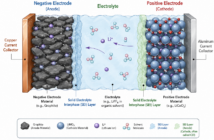
The SINTEF battery uses modified cobalt free, lithium-nickel-manganese-oxide for the cathode, that delivers high voltage and energy density. While the anode is a new silicon-graphite composite for strength, stability, and battery endurance.
The scientists used a novel way to assemble their cathodes, anodes, and prototype electrolyte. This involved the use of ‘special binders and separators’, that ‘repaired minor damage along the way’. These ingredients allowed the batteries to protect and repair themselves, which in turn helped extend their lifespan.

More Information
Single Crystal EV Battery For A Million Miles
EVs Close The Longevity Gap With Ice