Methane is the main constituent of the natural gas we may use for cooking, heating, and powering vehicles. We note that this is a greenhouse gas, but at least it is a step away from coal and oil. Researchers at Technical University of Vienna have found a way to convert used nickel-metal-hydride battery waste to valuable methane, but only after recovering the nickel first.
Producing Nickel and Methane from Battery Waste
The Technical University of Vienna overview, that we link to below, is quite complex, and so we begin with a brief introduction:
- Recycling and recovering nickel-metal-hydride battery materials is technologically challenging.
- Recovering nickel from used batteries and production scrap, could meet 18% of European requirements.
- Current UK and European recycling capacity is only around 10% of projected 2030 targets.
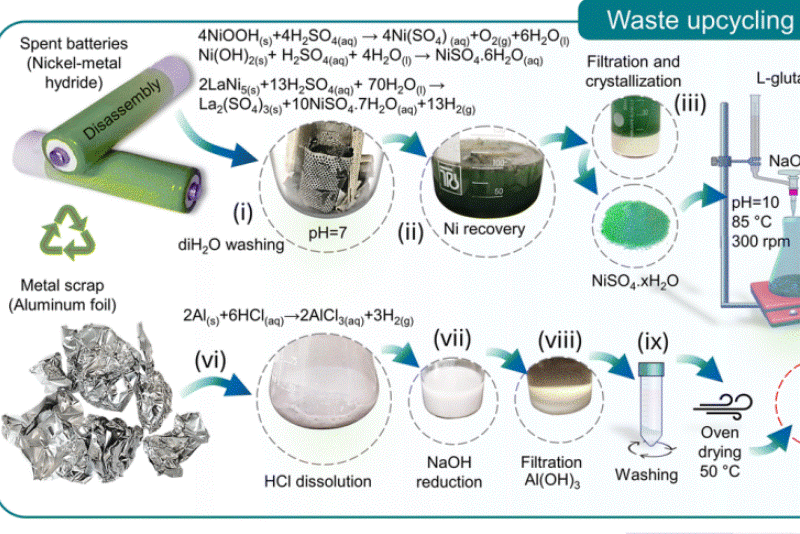
- The researchers used a two-step process, which allowed them to convert battery waste to valuable methane.
First, they extracted the nickel from used nickel-metal-hydride batteries, and set it to one side. Then they laid their hands on a supply of used aluminum foil, and produced aluminum oxide from it.
Aluminum oxide is a compound of aluminum and oxygen that has relatively high thermal conductivity, and catalyses a variety of industrial processes. It is also widely used to remove water from gas streams.
Finally, the Vienna team converted some of the recovered nicked and aluminum oxide into a powerful nanocatalyst, in an environmentally friendly way.
“Our nanocatalyst consists of 92-96% aluminum oxide, and 4-8% nickel,” explains Prof Rupprechter. “This is ideal for converting the greenhouse gas carbon dioxide, together with hydrogen, into methane.
“Our process for converting nickel-metal-hydride battery waste to valuable methane requires neither high pressure, nor high temperatures,” he continues. “The catalyst works at normal atmospheric pressure, and an easily achievable temperature of 250°C / 482°F .”
“Used catalysts can be broken down back into their original components, so that they can be reused, closing the sustainability loop,” adds Dr. Qaisar Maqbool. “This ensures that the entire process remains environmentally friendly, and that the amount of waste is minimized.”
More Information
Green Nickel for Sustainable Electrification
Why We Owe Our Life to CO2 and Methane
Preview Image: Characterization Of Prepared Nanocatalyst