

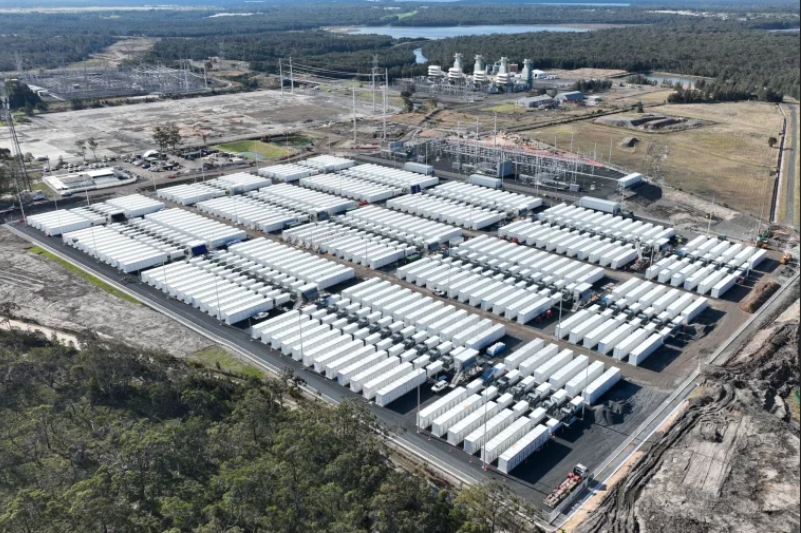
Mega batteries cushion utility grids by balancing supply and demand, in their current phase of development. However, we do have high hopes that someday they will carry us through long dark nights, when renewable energy falls away. The Waratah super battery cushion in Australia is a bold step towards that vision.
More Than a Super Battery Cushion In the Making
The first phase of the Waratah project has begun operating outside the New South Wales town of the same name. The New South Wales EnergyCo mouthpiece believes the giant battery will become the World’s largest of its kind, when it completes by the end of 2025.
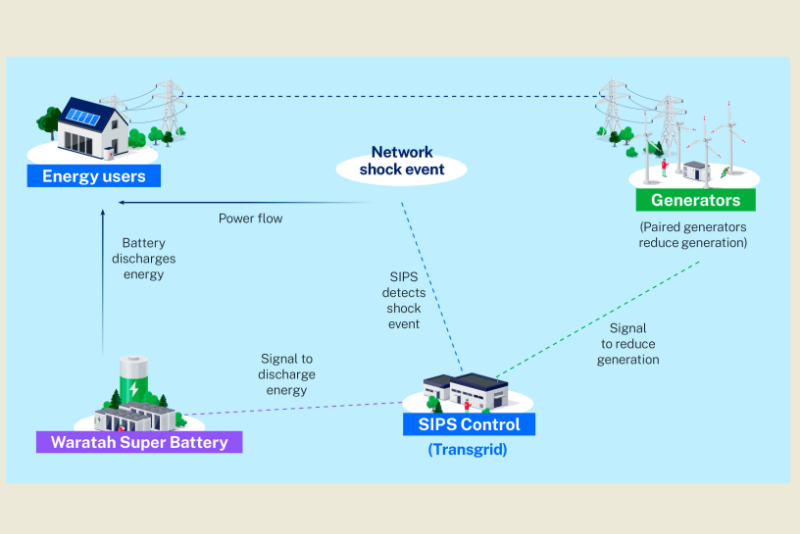
The mega battery project is more than the name suggests. That’s because it also incorporates three system strategies. These work together to help assure grid stability:
- An over-arching control system that ensures everything synchronizes.
- Arrangements for paired generation services with other networks.
- Upgrades to the existing New South Wales transmission network.
The Australian Energy Regulator confirms the overall aim of the project is to increase power transfer capacity on transmission lines. These connect generation in the northern and southern regions of New South Wales, to the Sydney, Newcastle and Wollongong regions.
Key Numbers Highlight Waratah Storage Cushion
The Waratah super battery cushion, when complete, should deliver 850 megawatts / 1,680 megawatt-hours according to EnergyCo. It will have an active capacity of at least 700 MW, and a guaranteed usable storage capacity of at least 1,400 megawatt hours.
This means that the battery installation should be able to deliver close to 850 megawatts for two continuous hours. That amount of energy is equivalent to a large gas or nuclear power station. It should therefore be sufficient to power 640,000 to 800,000 homes for two hours.
This is indeed a significant step towards a vision where renewable energy and batteries combine, and contribute more power to the grid than any other resource.
More Information
400MW Battery Storage Project In Germany
Hydro Storage In an Underground Well
Preview Image: First Stage of Waratah Storage


