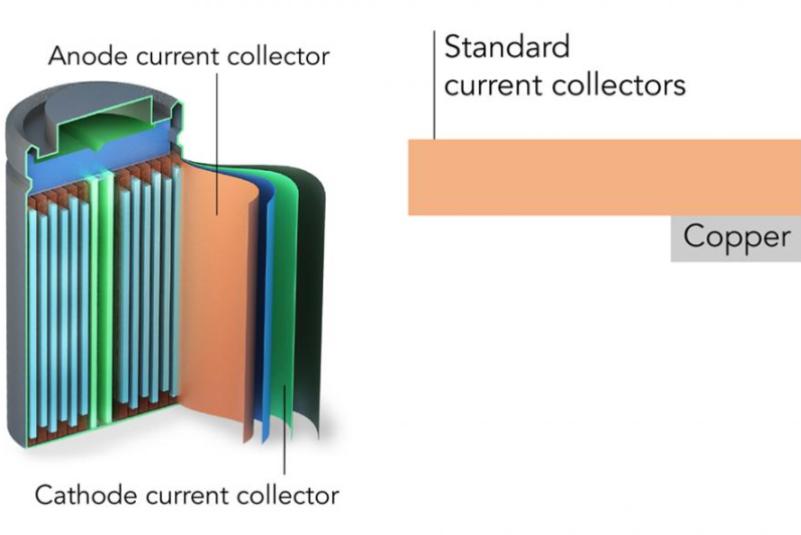
The role of current collectors in batteries is vital. They keep a battery in contact with the outside world via an external circuit. A collector achieves this by providing a good mechanical and electrical connection. This ensures a secure link between the external circuit, and the battery’s active material, thanks to this approach:
- There is a low-resistance highway for electrons entering the battery during charging, and leaving the battery while discharging.
- The active material receives physical reinforcement, thanks to it acting as a coating on the metallic current collector.
- The collector also acts as interface between the electrodes, and the external battery tabs conveying the electrical current.
Materials in Lithium-Ion Battery Current Collectors
- The current collector on the anode is typically copper foil. This is a highly conductive and stable material.
- The current collector on the cathode is typically aluminum foil. This forms a stable layer and resists corrosion.
Both foils are very thin on a micrometer scale. As a result, they add very little weight. This is important because the collector only collects, but does not store energy.
However, foils are not the only current collectors, especially in high power or next-generation cells. Other options include mesh, foam, etched, coated, or 3D-structured materials, according to the role of the current collector in a particular battery.
How Batteries Cannot Do Without Matched Collectors
- A poorly-matched current collector can increase internal battery resistance. This may reduce power, increase warming, and reduce battery efficiency.
- Electrodes expand and contract during battery discharging and charging. A matched current collector stays in contact with the active material and does not break it down.
- Current collector materials must be corrosion resistant. They should be as thin and light as possible, so not to affect energy-per-weight, and energy-per-volume ratios.
More Information
Novel Current Collector for Zinc-Ion Batteries