Researchers at University of Auckland Department of Chemical and Materials Engineering in New Zealand, have made a dramatic announcement. On October 20, 2025, they told the world of their breakthrough battery anode material. This could power electrical vehicles for longer, they say, as well as other exciting advantages.
Fresh Approach Delivers Breakthrough Battery Anode
Professor Peng Cao and Dr Kumar Jena set out to invent an electric car battery, delivering a longer driving range. They knew their answer lay in a novel anode material that could replace traditional graphite. But they needed something new, and out of the box to achieve this.
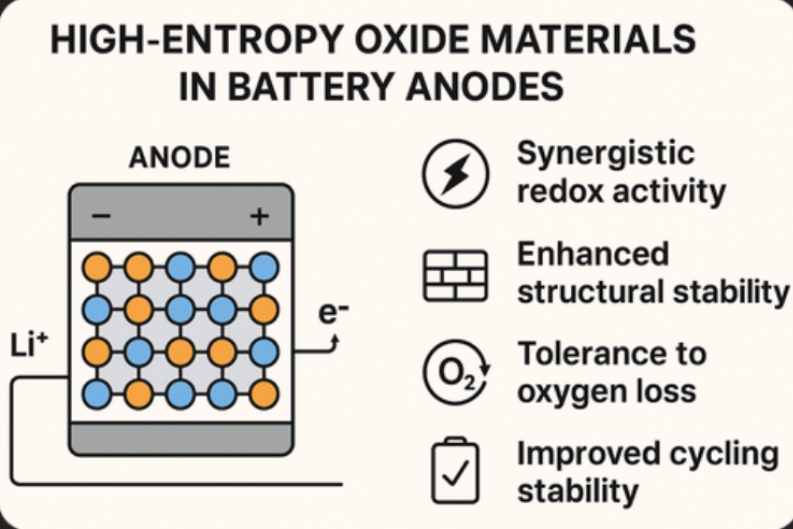
And so Cao and Jena set out to invent a brand new, high-entropy oxide anode material. In other words, a substance that merged several different materials into one. However, they have not divulged the particular materials they used, because they are commercializing their new technology.
“Our research shows that this new material could increase energy storage and improve battery lifespan,“ they advise in the University announcement which we link to below. “In practical terms, this means electric vehicles could drive further and their batteries would be more durable.
If the two scientists are successful, then their new material could replace graphite, the standard anode in lithium-ion batteries. These batteries are central to electric vehicles and clean energy storage, so improvements to them should also support carbon-neutral goals.”
More About High-Entropy Oxide Battery Materials
We were intrigued by this new technology, and investigated further. We learned that high-entropy oxide materials have five metal positive cations, randomly distributed in a single lattice.
These materials offer exciting new directions for battery research. Scientists are learning to use high-entropy oxides in anodes – and alternatively cathodes – in lithium-ion, sodium-ion, and potassium-ion batteries.
High-entropy oxides combine five or more different positive metal cations to achieve synergistic redox reactions, as well as enhancing structural cycling stability.
“We hope our breakthrough battery anode material can directly replace existing battery materials, and benefit both industry and communities,” observes Professor Peng Cao.
More Information
Ilmenite Anode Instead of Graphite