Four specialist teams in Baden-Württemberg in Germany, have come together to blend fiber, non-woven, and semiconductor technologies. They have developed an innovative battery anode material leading to 250% more powerful lithium-ion batteries, and with more responsible environmental footprints too. We investigate further …
A Facile Project for More Powerful Lithium-Ion Batteries
The Facile project, as the team members call their initiative, recalls their open-ended thinking. They are addressing the entire battery value chain, from material development all the way to cell production.
“The project goes to develop silicon anodes on flexible nonwoven fabric substrates”, explains Prof. Dr. Markus Hölzle. “These compensate for significant volume changes in the material, and will result in powerful, durable, and sustainable batteries.”
You see, conventional lithium-ion battery anodes (their negative poles) are traditionally graphite materials. These may store lithium at a rate of up to 370 milliamp hours per gram. But silicon can potentially store ten-times more energy, and is abundantly available worldwide.
Towards 250% Greater Energy Storage Density
The project team’s goal, as we mentioned earlier, is developing 250% more powerful lithium-ion storage cells. However, the challenge the scientists face in their laboratory, is coping with significant silicon volume changes during cycling.
Silicon anodes can soon crack and peel during battery charging and discharging. But the scientists based in Baden-Württemberg, Germany have a trick up their sleeves that could solve this impasse.
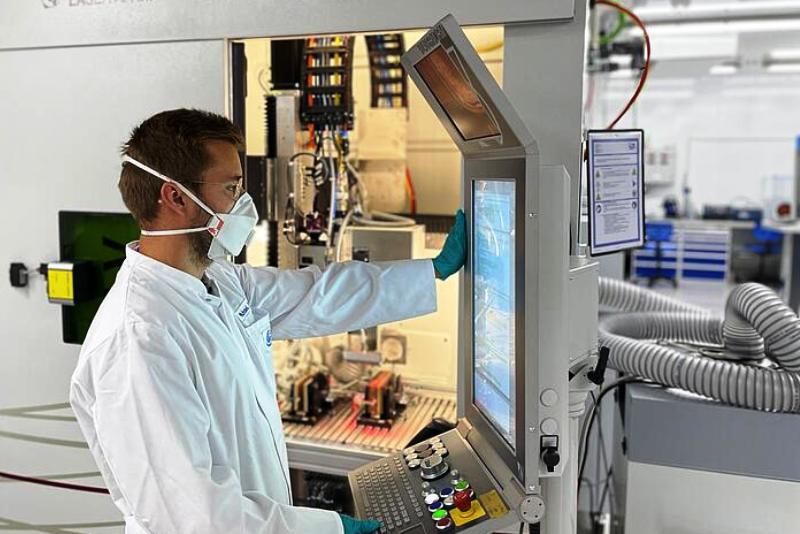
They are developing silicon anodes on fiber-based, electrically-conductive non-woven substrates. These, they say, can accommodate the volume changes in silicon. And they have already trialed small test cells that deliver this promise.
As we write, the scientists are back in their laboratory, working on ways to upscale their break through for commercial consumption. Their initiative addresses all the necessary stages, through to producing larger volumes of 250% more powerful lithium-ion batteries for consumers.
More Information
Double Layer Anodes in Silicon Batteries
Silicon-Graphite Anodes – The Way Forward?