Silicon-based batteries are a lithium-ion variety with their own special anodes. Battery manufacturers either add silicon to the graphite material, or use pure silicon as the current collector. These arrangements increase density leading to longer-lasting batteries. Scientists at Queen Mary University in London, have developed and tested double layer anodes in silicon batteries.
Excellent Results With Double-Layer Silicon Anodes
This innovative approach could lead to 20-30% cheaper batteries, faster charging, and longer-driving-range electric vehicles. We should not under-estimate the potential of achieving this, in the context of global warming.
The press release that we link to below confirms two important aspects underpinning the graphite / silicon composite anode:
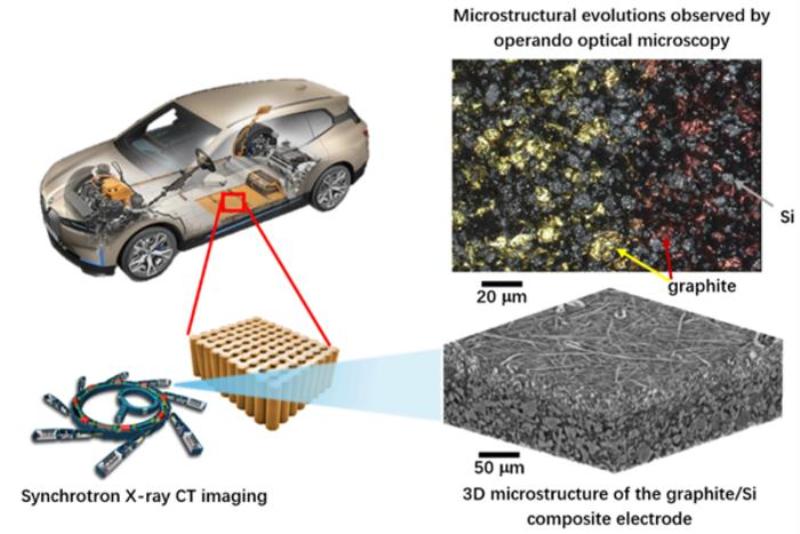
- Fundamental science guided the research. This included real-time-imaging to observe how the anode functioned.
- The findings hint at “remarkable improvements in cyclic stability, and fast-charging performance of automotive batteries”.
More About the Double Layer Anodes
The scientists at Queen Mary University in London, regard silicon as a promising anode for high energy batteries. However, the volume of the material unfortunately changes as ions enter and leave, during charging and discharging.
This ‘flexing’ causes fairly rapid degradation of silicon-based anodes.Therefore, the scientists reasoned, these anodes required modifications, based on their observations while the battery operated. This logic lead them to investigate double layer anodes in silicon batteries.
What the Scientists Found When They Looked
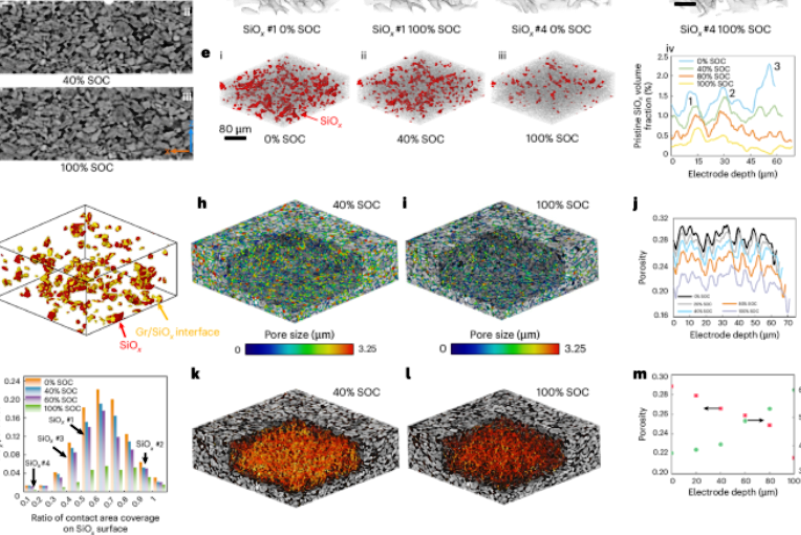
The researchers watched what actually happened to various graphite / silicon composite anodes during discharging and recharging. They noted how the performance of the silicon particles depended on the structure of the graphite composite material.
The team were particularly interested in how the silicon particles behaved, and how this risked lithium plating. They noted that the silicon’s performance was “heavily influenced by the expansion of the carbon-binder domain, and the decrease in porosity”.
The scientists at Queen Mary University in London, concluded that a “tailored double-layer graphite / silicon composite anode design would be an improvement. This was because it exhibited “lower polarization and capacity decay, compared with conventional graphite / silicon electrode formulations”.
More Information
Silicon-Graphite Anodes – The Way Forward?
Silicon Carbon Anodes Add New Dimensions
Preview Image: Graphite / Silicon Composite Anode