Indigo is the second last color in the spectrum, between blue and violet. Although we are more likely to remember it as the color of our blue jeans. Indigo blue dye is an organic compound made from indigofera plants that belong to the pea family. We were taken aback by reports of indigo blue dye going greener. However, when we investigated we found this was not the whole truth.
Indigo Blue Dye and Solid State Batteries
Solid state batteries are being held back due to a fundamental flaw, according to Canadian researchers. These scientists from Concordia, Saskatchewan, and Western Ontario Universities summarise the situation as follows, in their report we link to below:
All-solid-state batteries offer a potential solution. Although chemical and mechanical incompatibility between organic electrodes and inorganic solid electrolytes limit real capacity and cycling stability.
When we spoke of indigo blue dye going greener, we had sustainable batteries in mind, and the role of indigo in the solution. We already knew this material is an organic semiconductor, thanks to research on Wikipedia. Although what the Concordia-led team discovered is more remarkable.
A Greener Role for ‘The Blue Jeans Plant’
Organic materials, like indigo blue dye, generally do not work well with inorganic materials in batteries. However, this situation changed when the scientists managed the reaction with a solid inorganic electrolyte, as described by Tech Explore.
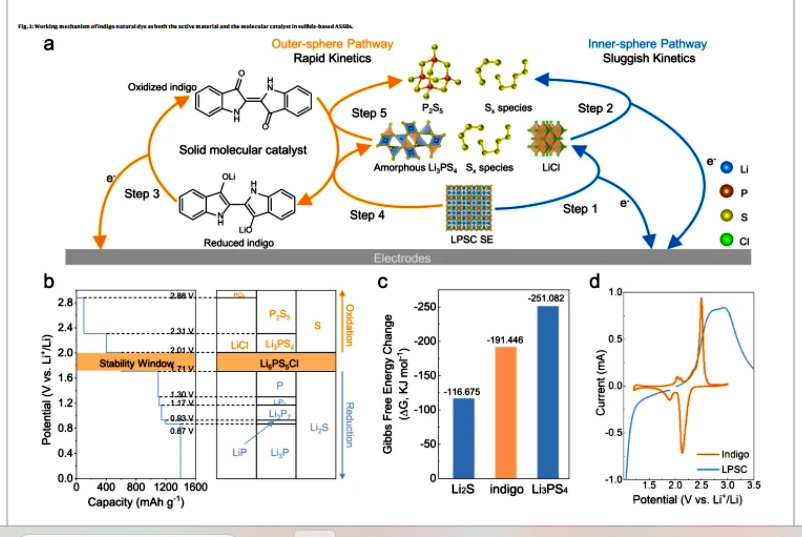
The team discovered that indigo blue dye is able to support two core reactions inside solid-state batteries, and deliver three benefits. These gains include greater energy capacity, more charge-discharge cycles, and improved cold temperature performance too.
The scientists watched as organic indigo stored and released the active ions, while also gently activating the solid electrolyte to store energy. This twinning of efforts between indigo dye and electrolyte boosted the battery’s overall capacity, far more than what either material could deliver on its own.
More Information
Towards Sustainable High Capacity Batteries
Dry Coating Active Battery Materials at VW
Preview Image: Working Mechanism of Indigo Dye