Scientists in China have developed a more stable lithium anode-electrolyte interface, that improves lithium metal battery stability, and safety. If their invention goes to market, then this could be a significant step forward. Batteries with lithium metal anodes have hinted at significantly greater storage capacity for a while. However, problems at their anode-electrolyte interface have consistently let them down.
Issues Affecting Lithium Anode–Electrolyte Stability
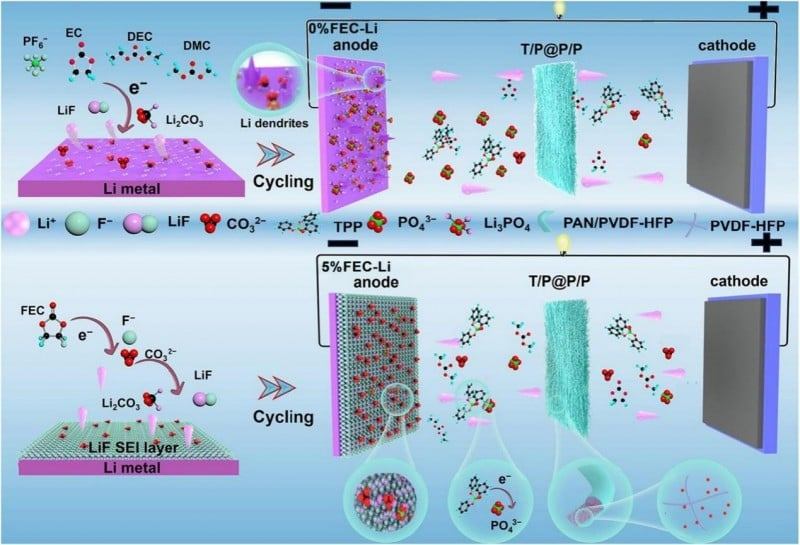
Lithium metal batteries are prone to dendrites, leading to short-circuiting electrodes and even fires. Their chemistry at their liquid-electrode-electrolyte interfaces is also unstable, and so these batteries largely remain at theoretical level:
- There have been efforts to moderate these deficiencies using semi-solid gel polymer electrolytes, although these still require fire suppressors.
- Organic triphenyl phosphates (TTP) have improved fire resistance, but penetrate through to the lithium metal, corroding it.
Hence we find ourselves in a position where we can improve lithium metal battery safety, but this comes at significantly shorter battery life. The Chinese scientists decided they needed a fresh approach, and achieved a stable lithium anode-electrolyte interface.
Mitigating TTP Corrosion With a Solid Electrolyte Interphase
The researchers designed a flame retardant gel polymer electrolyte, which they infused with a high concentration of TTP triphenyl phosphate flame retardant. They teamed this innovation with a lithium fluoride-rich solid electrolyte interface, that they pre-formed on a lithium metal anode.
This combination simultaneously suppressed lithium metal corrosion, accelerated lithium-ion shuttling, and enabled stable charging and discharging, even when delivering high current quickly.
Laboratory tests confirmed stable operation after over 1,000 hours, 98.9% capacity after 1,500 cycles, and 81.7% capacity after 6,000 cycles. The researchers confirmed this charge / discharge cycle life performance at -10 C / + 14 F temperatures.
“Our study compellingly shows that precise interface engineering is essential to advancing both the safety and durability of lithium metal batteries,” observes the lead corresponding scientist.
More Information
Failure Paths in Lithium Metal Batteries
Solid Electrolyte Interface Trips Lithium-Metal
Preview Image: Illustration of Key Issues