The glue in a battery that binds it, is typically a polymer that holds the bits of the electrodes together. Achieving this goal ensures even coatings of active materials on current collectors, and overall battery stability. We examine this critical material ‘behind the scenes’, that most battery users don’t even know.
The Battery Glue That Creates the Team
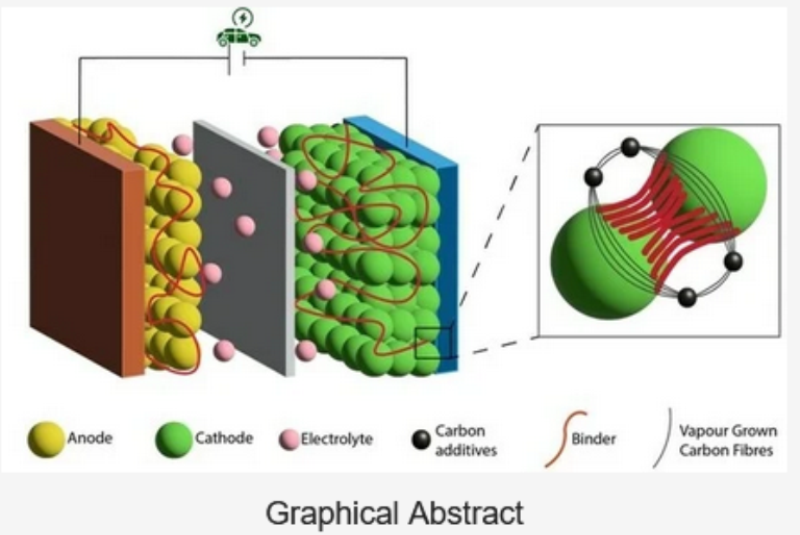
The four main players in a battery are its anode, its cathode, its electrolyte, and its separator. The anode stores the energy, while the cathode releases the ions through the electrolyte. Finally, the separator keeps the anode and cathode apart, so they cannot touch and short-circuit their electrical charges.
It follows that there would be chemical chaos if these parts of a battery were rattling around loose in a battery case. Various other parts form a ‘sideshow’ that maintains ‘law and order’. The binder that holds the bits of the electrodes together is arguably the most important of these.
The battery electrodes attach to metallic current collectors, that connect to the outside world. The electrodes use these collectors to receive current from a battery charger, and release this current to an external device when it calls for it. But the current collectors also connect to the electrodes, that orchestrate the chemistry inside.
Binding the Electrode Team Together
When we think about it, we realize the interface between the electrodes and the current collectors is critical. The parts of our deep cycle, gel lead acid batteries connect physically inside. However, battery chemists don’t have that abundant space inside compact cylindrical, prismatic and cell batteries.
And so the electrodes in lithium-ion batteries – to cite one example – are actually slurry mixtures sprayed onto metal current collectors. These mixtures contain active materials, conductive additives, binders, and a solvent in specific ratios according to Ingensol.
That binder is the glue in a battery that joins the electrodes and current collectors together. It is an often-overlooked ‘secret sauce’, that ensures electric current flows efficiently and smoothly in an out of batteries. This makes the binder more that ‘just an adhesive’. It is a critical player in battery stability.
More Information
Quick Release Battery Binder Recycles Faster