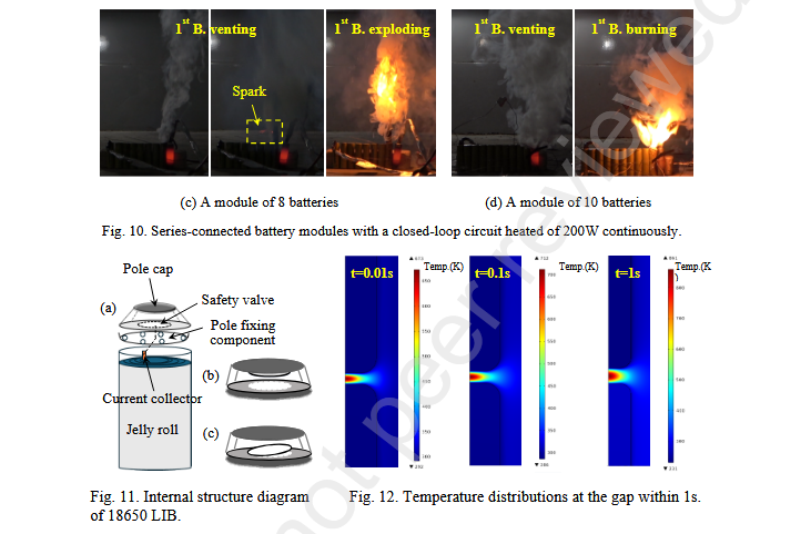
Thermal runaway in lithium-ion batteries challenges their suitability for energy storage and electric vehicle applications. A team of Chinese scientists studied ignition in lithium-ion 18650 cylindrical battery cells, and reached two conclusions:
- An internal short circuit is mainly responsible for ignition in an open-loop circuit.
- Whereas, the external circuit state is the main concern in a closed-loop circuit.
In a closed loop, the battery’s circuit is complete so current flows, whereas in an open loop the circuit is broken, and so no current flows.
Pathways to Ignition in Lithium-Ion 18650 Batteries
The scientists who wrote the research paper that we link to below, examined how and why lithium-ion batteries catch fire. They knew their temperatures can rise rapidly, when something stresses or damages the battery interior.
That ‘something’ includes a short circuit, overheating, overcharging, or mechanical abuse causing damage. The scientists’ work included experiments, and simulations backed up by solid scientific theory.
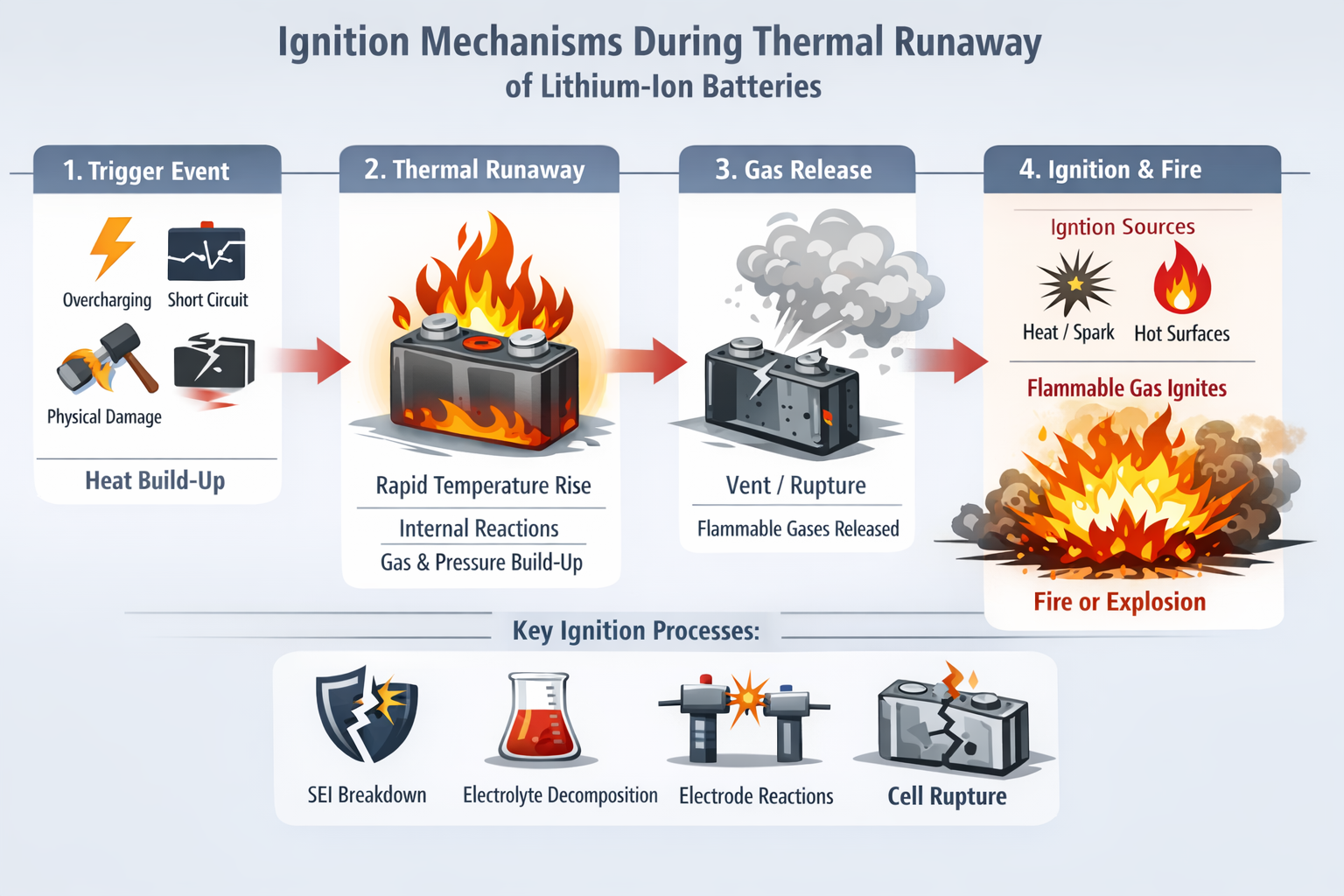
Ignition in lithium-ion 18650 batteries of all shapes and sizes begins in their electrolyte. This electrolyte is flammable, meaning it can burn. The electrolyte breaks down at high temperatures, releasing flammable gases.
These gases increase the internal pressure inside the battery case, to the point that it starts leaking or even bursts open. These gases escape from the battery to the outside world, where there is abundant oxygen. If the circumstances are right the gases can catch fire, and even explode.
The Chinese scientists applied their minds to the chemical and physical events inside a battery case. Factors of interest included electrolyte–interface breakdown, decomposition of the electrolyte, reactions between electrodes, and structural failure.
These aspects all contributed to the rate of ignition in the lithium-ion 18650 batteries that they tested. Understanding these mechanisms should contribute to more effective battery safety systems, and help prevent dangerous battery failures and fires.
More Information
What’s Inside Those Lithium-Ion Batteries?
Canadian Standards For Lithium-Ion Batteries