Underwriters Laboratory (UL) Standards and Engagement, describes lithium-ion batteries as an increasingly urgent safety hazard on aircraft. Battery thermal incidents in aviation are surging, it continues, in an alarming report on March 10, 2026.
Thermal Incidents Increasing at Alarming Rate
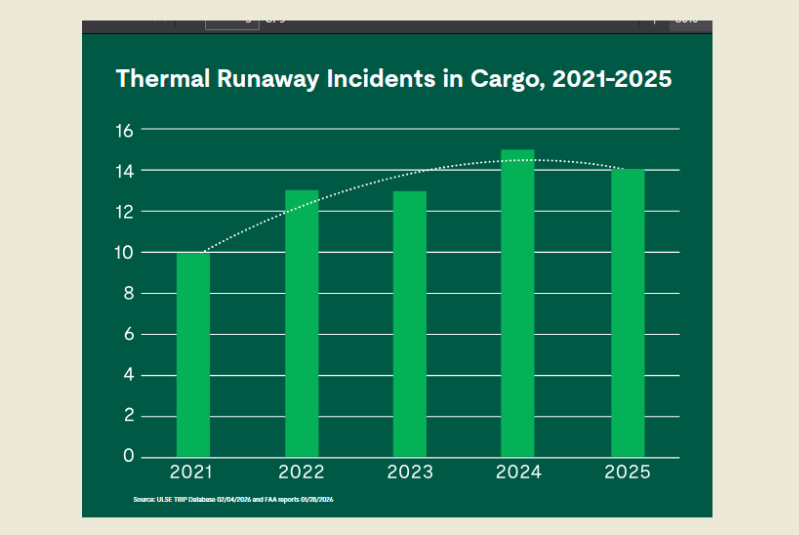
The UL authority says lithium-ion batteries are an urgent risk driven by consumer demand. You could read their full report at the link below, but the bottom line is battery thermal incidents in aviation rose by 40% between 2021 and 2025.
These incidents occurred when lithium-ion batteries entered thermal runaway. This is a chain reaction where internal heat rises uncontrollably, often leading to fire, explosion, and release of toxic gases.
Underwriters Laboratory Standards and Engagement surveyed a number of expert sources. These included cargo airlines, government bodies, freight forwarders, e-commerce stakeholders, manufacturers, and individual shippers.
They uncovered, ‘a supply chain strained by fragmentation, uneven accountability, and commercial pressures that prioritize speed over safety’. These conditions ‘allow that risk to persist,’ they point out.
Glaring Gaps in Transport Aviation
There are, however, opportunities to strengthen accountability, the report continues. Coordination and safety should lead to a stronger and more secure global supply chain, with the necessary cooperation:
Battery Quality and Shipper Behavior
The report highlights battery quality and shipper behaviour, as core drivers of battery thermal runaway incidents in aviation. This leaves the onus on airlines to manage hazards, some of which are beyond their scope.
Geography And Thermal Incidents
Geography is a predictor of thermal risk, the report continues. The drivers here are inconsistent manufacturing quality and enforcement. More than half of known-origin incidents began in a handful of Asian airports.
Over-Dependence on Trust
Underwriters Laboratory Standards and Engagement concludes that ‘the system is built on trust’. Each link in the supply chain depends on the previous one complying, and this results in fragmented responsibility for thermal runaway risks.
More Information
South Korea Aircraft Battery Rules Tighten
Passenger Aircraft Battery Fire Precautions