We have have often wondered how something as delicate as a dendrites tip could penetrate through a hard ceramic electrolyte. This is one of the primary reasons why solid-state batteries short circuit, and yet until now, it has remained a mystery.
How Solid-State Batteries Short Circuit
Scientists at Max Planck Institute for Sustainable Materials in Düsseldorf, Germany, have uncovered an important clue using garnet solid electrolyte.
They followed through on this topic since all-solid-state lithium-based batteries, are otherwise such a promising option.
That’s because these batteries replace flammable liquid electrolytes and graphite anodes with solid ones and lithium metal, which offer a safe, high energy option.
But first the researchers needed to understand why these solid-state batteries short circuit. And so they investigated how soft dendrite tips could penetrate hard garnet electrolyte.
To date the difficulty has been understanding the mechanics of the plant-like, delicate dendrite growths emerging from the battery anode.
The Max Planck Institute focused on the composition and micro structure of the dendrite tip, using electron microscopy, and micro mechanical fracture models.
They Watched Dendrites Exploiting Weaknesses
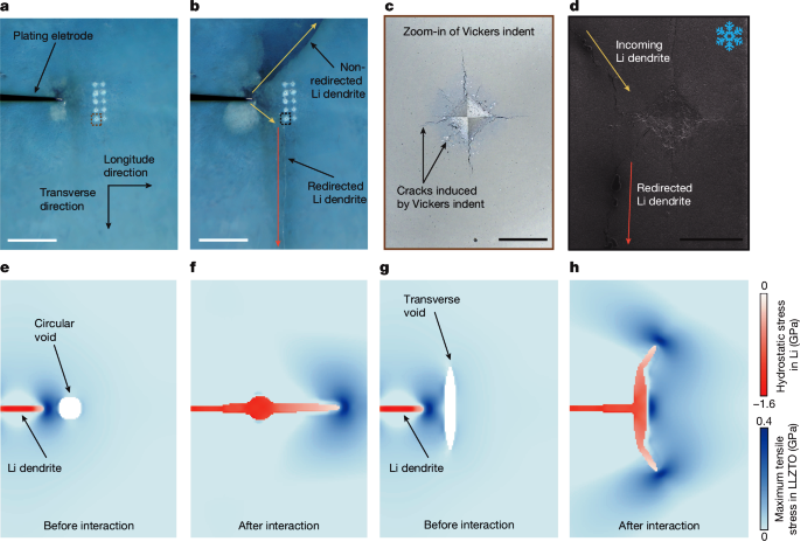
The scientists made a giant leap forward. They directly observed the lithium dendrites filling nano scale-size cracks in the solid electrolyte, and gradually enlarging them.
The researchers saw, first hand, how the plastic nature of the plant-like growths allowed them to gradually increase in volume.
This mechanical force applied considerable stress to the solid garnet electrolyte, extending the cracks in various directions.
It would only be a matter of time before the solid-state battery electrodes short circuited. Then the curious minds of the researchers turned to how to prevent this happening.
They came up with the most interesting idea of leading the dendrites away from the opposing electrode, where it would be harmless.
Why not artificially engineer open voids in the solid electrolyte, they wondered, that could accept the dendrites? This sounds like an excellent way to stop solid-state batteries short circuiting. It is certainly worth a try.
More information
The Origin of Dendrites Revealed By NMR
Thorny Dendrites in Lithium-Ion Batteries