Solid electrolyte membranes can cut solid-state battery (SSB) production costs, according to an article on News Wise on January 15, 2026. There, the South Korean National Research Council of Science and Technology (KRISS) explains several benefits. These include reducing oxide-based solid electrolyte production costs, by an amazing 90% by saving on lithium.
More Benefits From Solid Electrolyte Membranes
Traditional lithium-ion batteries use liquid electrolytes, which may be vulnerable to sudden fires and explosions. Solid electrolytes are safer, but there are drawbacks to manufacturing them, including production costs.
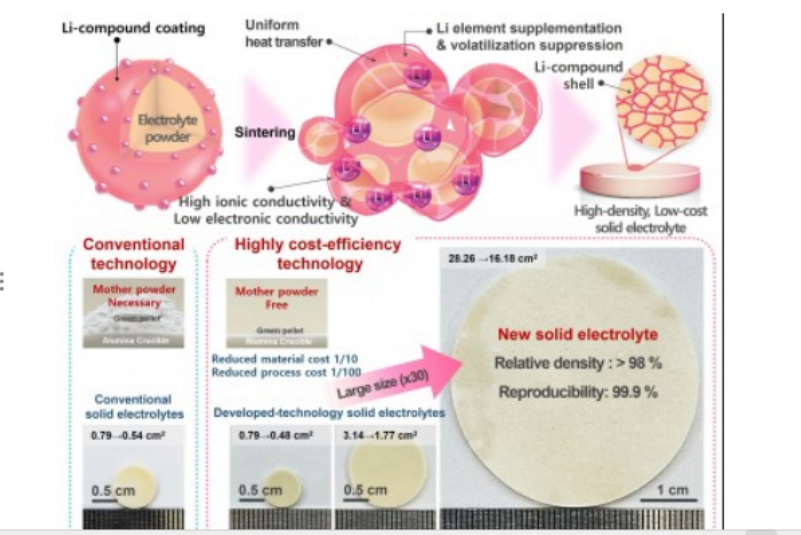
Scientists at KRISS resolved this issue by coating solid electrolyte powders with multifunctional compounds, able to perform several tasks. For this exercise they focused on oxide-based batteries, that are popular for their high energy density.
These particular batteries use ‘garnet type’ solid electrolytes for high ion-conductivity, and chemical stability with lithium metal. Although at the same time, they tend to develop interfacial resistance at electrodes, and are vulnerable to dendrites.
Current practices to manage these issues include high-temperature, high-pressure sintering. This process compacts the electrolyte powder at temperatures greater than 1,000 °C / 1,830 °F, but it is expensive.
Producing Affordable Solid Electrolyte Membranes
The traditional high-temperature, high-pressure sintering process encourages lithium in the electrolyte material to evaporate. This negatively affects solid electrolyte stability, while also slowing the movement of ions and increasing resistance at electrodes.
Previous attempts to fix this involved applying more lithium-based electrolyte than actually required, and then sacrificing most of it in the process. However, the KRISS researchers developed an alternative method that reduced this wastage by 90%:
- They thinly coated the solid electrolyte powder with lithium–aluminum–oxide multifunctional compounds.
- This strategy prevented lithium evaporation, while simultaneously enhancing inter-particle bonding.
This approach also optimized the intensity of the electrolyte material, and succeeded in producing high-strength solid electrolyte membranes, free from chemical and mechanical defects. While at the same time doubling the rate at which ions conduct during discharging and recharging cycles.
More Information
Better Solid Lithium Batteries
Solid State Battery Safety in Question
Preview Image: Solid Electrolyte Fabrication