Every battery needs two types of moving particles. Electrons travel through wires outside a battery. But this time, we focus on how ions travel through electrolytes inside a battery, in this article.
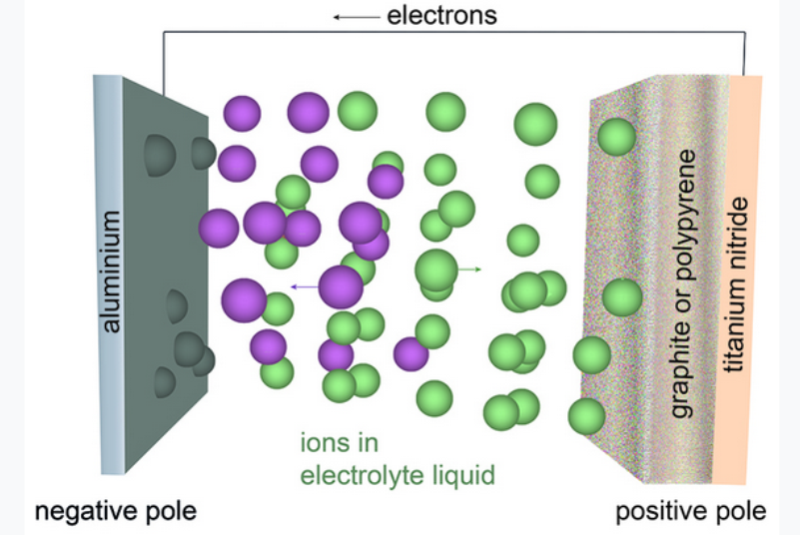
Ions do not use wires to connect them to the outside world. Instead, an electrolyte provides the pathway for them to travel between the electrodes. A battery could not deliver electrical energy without this facility.
How Ions Travel Through Electrolytes
When a battery discharges its stored energy, chemical reactions create ions at one electrode. These ions then move through the electrolyte toward the opposite electrode.
At the same time, electrons flow through an external circuit. This combined movement produces electric current.
Many rechargeable batteries use lithium ions or sodium ions. But these ions do not travel alone. Molecules in the electrolyte surround them and form a protective shell. The ions carry this shell with them as they move.
The speed of ion movement affects battery performance. Faster-moving ions can support rapid charging and discharging. Slower-moving ions limit power and charging speed.
The Composition of Electrolytes Matters
The nature of the material also influences how ions travel through electrolytes:
- Most lithium-ion batteries use liquid organic electrolytes. These liquids conduct ions well, and support high battery voltages. However, they can catch fire under certain conditions.
- Some batteries use water-based, aqueous electrolytes instead. Water improves safety and lowers cost. However, water limits battery voltage and energy storage.
- Engineers are also developing solid electrolytes. These may improve safety and reduce fire risks, although their performance may be slower.
An electrolyte, therefore, does not store energy itself. Instead, it acts as a ‘bridge’ for the ions, and allows the battery to operate. And that, in a nut shell, is how ions travel through electrolytes in some batteries.
More Information
The Origin of Ions In Batteries