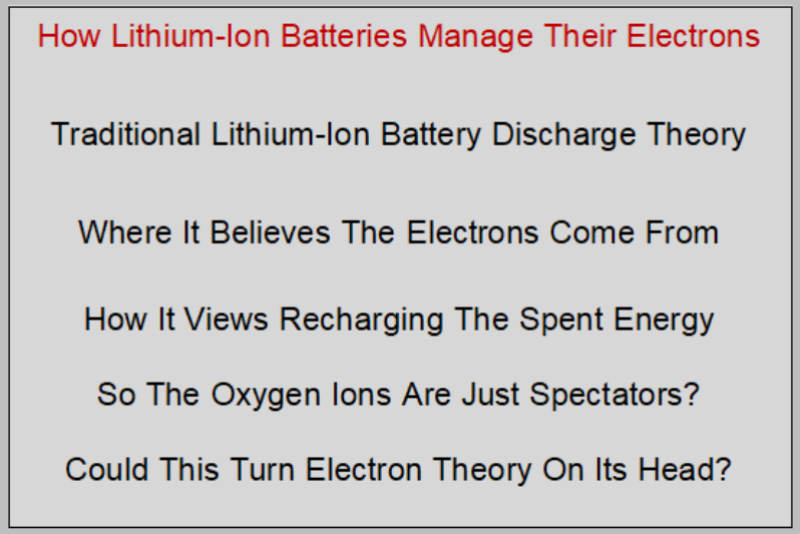
For many years scientists believed they understood how lithium-ion batteries manage their electrons inside them. But now we have news of a revolutionary new theory. Could this idea turn battery science on its head?
Traditional Lithium-Ion Battery Discharge Theory
The traditional model, as we understand it, holds that these batteries remove their lithium ions from their positive cathode electrodes. As these lithium ions move toward the negative electrode, electrons also leave that cathode and travel through the external circuit.
Where It Believes The Electrons Come From
The theory is that these electrons come mainly from metal atoms inside the cathode. Those metal atoms therefore change their electrical state as the battery charges and discharges, while also supplying or accepting electrons as required.
How It Views Recharging The Spent Energy
The generally-accepted theory of how lithium-ion batteries manage their electrons, continues in a similar vein. Apparently it says the lithium ions remain stored in the negative electrode until the battery delivers power.
The process reverses when recharging commences. The lithium ions travel back to the cathode, while the electrons flow through the circuit and return to the cathode as well. This allows the battery to store and release energy repeatedly.
So The Oxygen Ions Are Just Spectators?
As we see it in terms of current theory, the oxygen atoms in the cathode play little or no active role in the process. They are just part of the cathode structure, helping to hold the electrode together.
Could This Turn Electron Theory On Its Head?
Battery scientists at Warwick University in England, have challenged the traditional theory as to how lithium-ion batteries manage their electrons. According to their recent research, they claim that the electrons mainly come from the oxygen ions.
“Showing how and why oxygen ions participate,” they explain, “is important for determining how to improve our current batteries.” So does this turn traditional theory on its head. It certainly could give it cause for thought!
More Information
How Ions And Electrons Work Together