Dual-ion batteries waiting for their moment, are an emerging energy storage technology we have been monitoring for a while. They differ from conventional batteries in one important way, which we would like to share with you today.
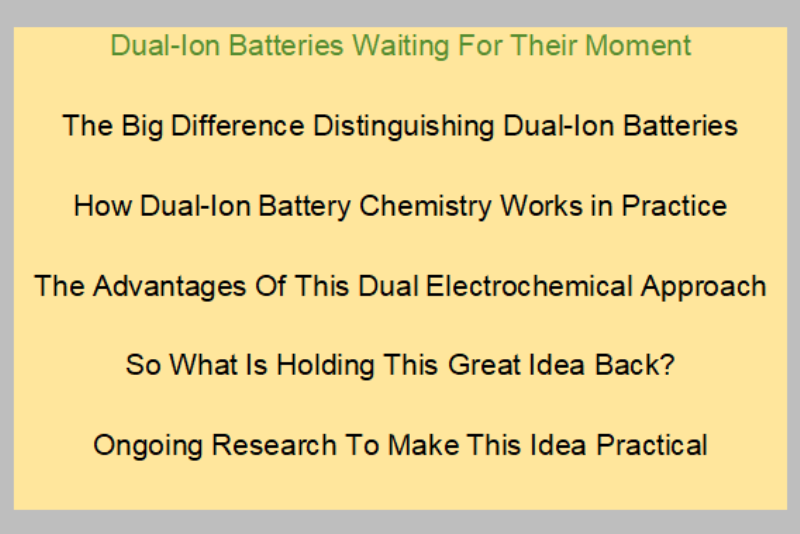
The Big Difference Distinguishing Dual-Ion Batteries
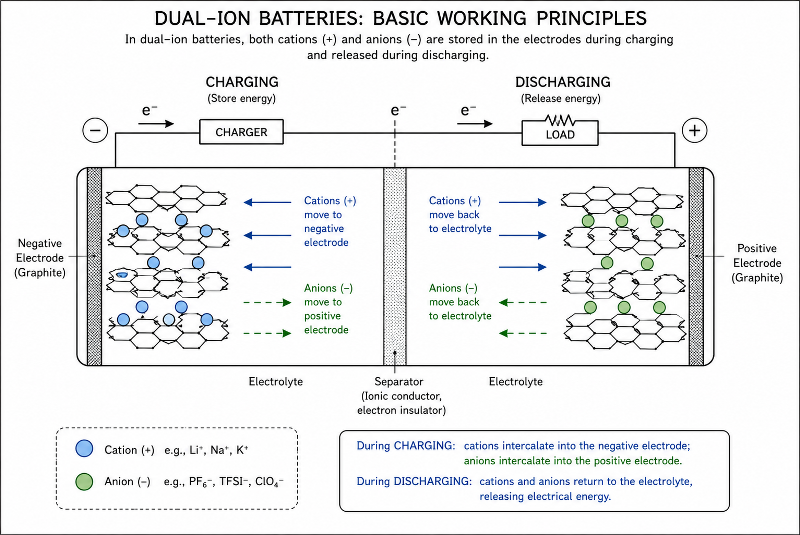
Conventional lithium-ion and sodium-ion batteries, move their cations into their electrodes during charging and discharging. Dual batteries double up this process. They shuttle both their positively charged cations and negatively charged anions, when storing and releasing energy. This gives the technology its ‘dual’ name.
How Dual-Ion Battery Chemistry Works in Practice
- Positive cations, which might be sodium or lithium, move from the electrolyte into the negative electrode, during charging.
- While negative anions from the electrolyte migrate to the positive electrode, which is usually graphite.
- When the battery discharges, both ion types return to the electrolyte, releasing electrical energy.
The Advantages Of This Dual Electrochemical Approach
Dual-ion batteries waiting for their day, mainly use simpler electrode materials, because both ions are actively involved. We believe this option should potentially be less expensive, making lower cost one of their main attractions. Graphite is also widely available.
We believe that dual batteries may also require less of the costly transition metals, such as cobalt and nickel we find in many lithium-ion batteries.
These batteries can also operate at relatively high voltages, making them suitable for applications demanding more power. A further advantage is their ability to charge quickly, thanks to rapid movement of ions within the electrolyte.
So What Is Holding This Great Idea Back?
Despite these advantages, several technical hurdles are still unresolved:
- The electrolyte needs to remain stable at the battery’s high voltage, yet many current electrolytes gradually decompose under these conditions.
- Energy density also remains lower than that of today’s best lithium-ion batteries, limiting driving range in electric vehicles for example.
- Furthermore, repeated insertion and removal of anions can slowly damage the graphite cathode, shortening battery life.
Ongoing Research To Make This Idea Practical
Battery scientists are working on new electrolyte and electrode materials to overcome these challenges. If successful, dual-ion batteries could become an affordable, fast-charging alternative for stationary energy storage and, eventually, electric transport.
More Information From Our Blog