The world before lead-acid batteries was a different place from what we now know. Electricity was only available in limited quantities from static electricity, or early electrostatic generators.
The Breakthrough Came In The Late Eighteenth Century
The breakthrough came at the close of the eighteenth century, when Alessandro Volta created the first practical battery. His voltaic pile consisted of alternating discs of complimentary metals, separated by pieces of material soaked in an electrolyte.
This ‘pile’ produced a continuous electrical current. It was a remarkable achievement! Because scientists could now carry out experiments using a steady source of electricity, rather than relying on brief electrical discharges.
Volta’s Invention Opened The World To Rapid Development
Scientists began experimenting with different metals and chemical combinations. Their goal was to produce stronger currents, and eventually, find ways to make electrical power more useful.
But one important problem remained. In the world before lead-acid batteries,they could not recharge what they had. When their materials were used up, they could no longer deliver enough electricity scientists could use.
Gaston Planté Develops The First Rechargeable Battery
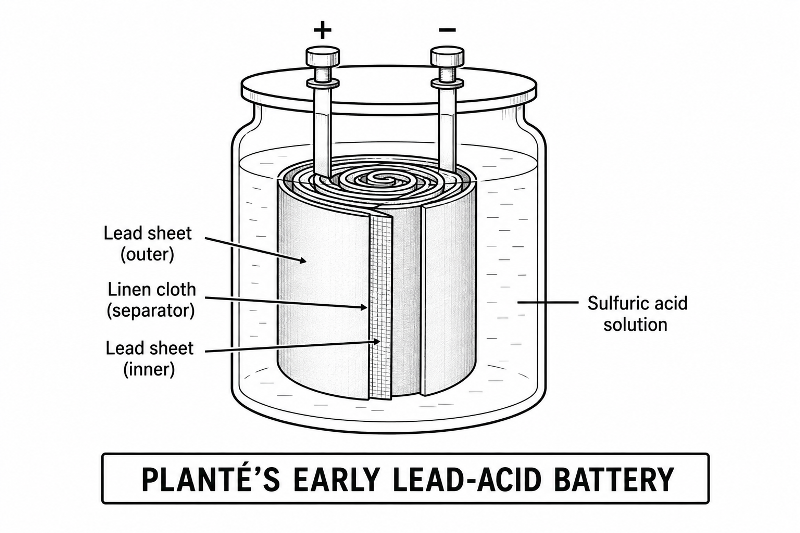
The next breakthrough came when French physicist Gaston Planté developed the first rechargeable lead-acid battery in 1860. This used two lead plates rolled in a spiral in a bath of sulfuric acid.
When electrical current passed through the battery, chemical changes took place at the plates. The process could then be reversed by passing current through the battery in the opposite direction.
This Simple Idea Changed Our World Of Batteries Forever
Planté’s lead-acid batteries could recharge and be used over and over again. They became invaluable for applications ranging from early electrical systems to electric vehicles, even in those days.
One Of The Most Important Moments In Battery History
The basic ingredients may seem ordinary to us: lead, sulfuric acid and special plates. Yet this combination created one of the most important rechargeable battery technologies in history. More than 160 years later, lead-acid batteries remain in use around the world.
More Information From Our Battery Blog