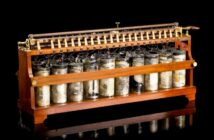
A scribe at Harvard University describes how the genius of one man invented the first rechargeable lead battery. Although his ‘pile secondaire’ was ahead of its time, in the sense he lacked a suitable device to charge his accumulator. We describe how Gaston Plantés lead-acid battery worked, but first let’s take a peek at the Gramme Machine that made it all possible.
The Key to Charging Gaston Plantés Lead-Acid Battery
Zénobe Théophile Gramme was a Belgian electrical engineer born in 1826. He invented an electrical generator capable of functioning as either a dynamo or a magneto. It generated direct current at higher voltages than previously possible when in dynamo mode. This made it possible to charge Gaston Plantés lead-acid battery to its full potential.

However, Gaston Planté did not invent the first rechargeable battery per se. That credit belongs to one Johann Wilhelm Ritter who created a pile of layered discs of copper and cardboard soaked in a brine of table salt. He was able to generate a transitory, ‘secondary’ current after it had been charged electrically, creating an early accumulator.
How the First Secondary Lead-Acid Battery Worked
Gaston Plantés lead-acid battery was a spiral roll of two sheets of pure lead in its original form. He separated the two sheets, which formed the electrodes, by rolling a linen cloth separator between them. Then he immersed his contraption in a glass jar of sulfuric acid solution, which liquid functioned as the electrolyte.
Planté presented a nine-cell version of his lead-acid battery to the Academy of Sciences the following year, 1860. However, his design was impractical for commercial applications. Camille Faure developed a practical version in 1881, which enjoyed great success in early electric cars.
More Information
Planté’s Choice of Lead & Why He Made It