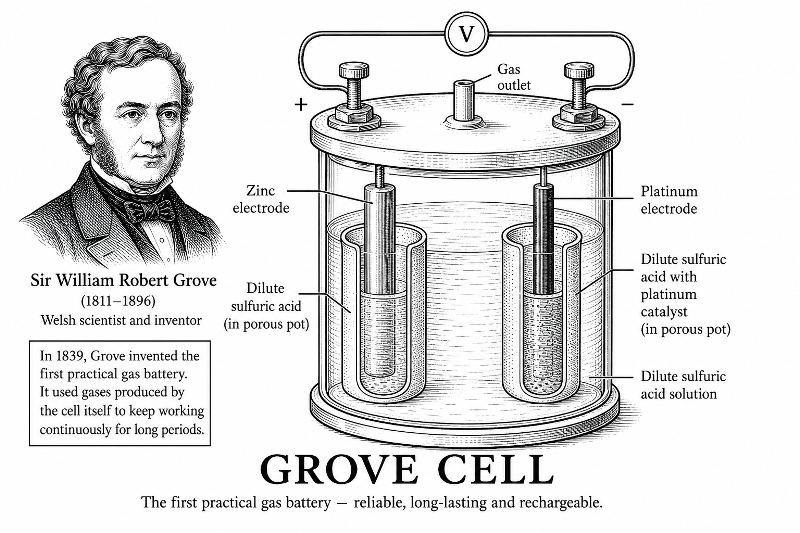
Battery researchers had made important improvements to the original Voltaic Pile, by the late 1830s. The Daniell cell, for example, produced a steadier electrical output. While the Grove Cell was a powerful improvement in this regard.
Inventors Wanted Even More Voltage And Current
However, inventors still wanted a battery that could deliver even greater voltage and stronger current. William Robert Grove, a Welsh lawyer and scientist, addressed this challenge in 1839.
Grove had been experimenting with different metals, acids and arrangements of electrodes. His work led to a powerful new cell that became known as the Grove Cell. It was a great improvement.
Grove Cell Used Different Liquids In a Porous Container
The Grove Cell was a powerful improvement using two different liquids separated by a porous ceramic container. A zinc electrode was immersed in dilute sulfuric acid, while a platinum electrode rested in concentrated nitric acid.
The porous pot allowed chemical interaction to continue while preventing the two liquids from mixing freely.
Grove Used Nitric Acid To Deal With Hydrogen Accumulation
One of Grove’s important contributions was using nitric acid to deal with a problem that affected earlier batteries. Hydrogen could build up around an electrode during operation, and interfere with the battery’s performance.
The nitric acid acted as an oxidizing agent, helping prevent this polarization.
The Result Was An Unusually Powerful Cell For Its Time
The result was an unusually powerful cell for its time. It produced about 1.9 volts. This was considerably more than the roughly 1.1 volts the Daniell cell provided.
Grove’s Cell Was Attractive For Demanding Applications
Was Grove’s battery was attractive for demanding applications, including early telegraph systems.Despite the use of costly platinum and toxic nitric acid.
Grove’s invention was another important step in battery development. It showed that better control of chemical reactions could produce considerably more electrical power from a practical cell.
More Information From Our Battery Blog