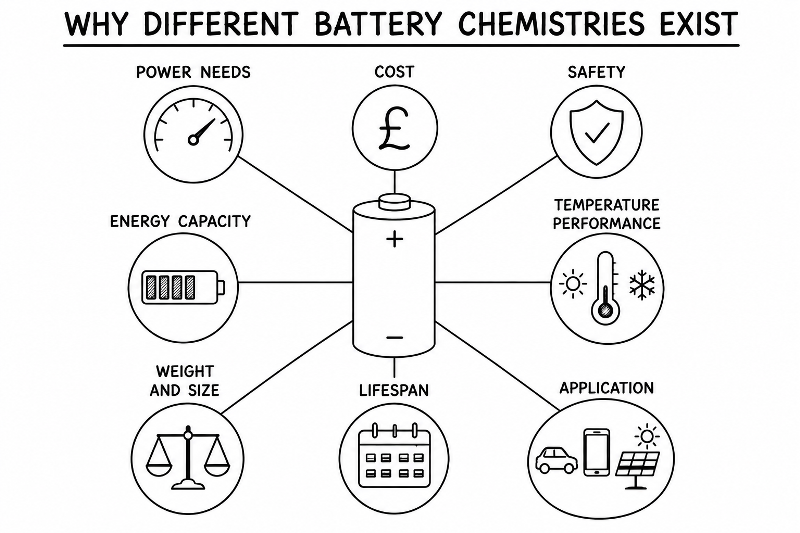
If all batteries worked in the same basic way, then why are there so many different types? The answer is simple. Different battery chemistries exist side by side, because no single battery can do every job well.
Batteries Use Different Chemistries For Good Reasons
Some batteries are designed to deliver large bursts of power. Others provide a small amount of electricity for many hours. Some recharge hundreds of times, while we can only use others once.
Price also matters in our world of batteries. A battery for starting a family car has different requirements from one powering a wristwatch, or storing electricity from solar panels.
Battery Safety is Another Important Consideration Nowadays
Different battery chemistries exist, but there’s a cost attached to safety too. Some battery chemistries are more stable than others. Some work better in very hot or very cold conditions.
Weight also influences battery design. Portable devices need lightweight batteries, while stationary systems can often use heavier ones if they offer lower cost or longer life.
Choosing The Right Chemistry For Our Application
Engineers must therefore choose the best battery materials for a job, rather than searching for one ‘perfect’ battery. This is why we have lead-acid, lithium-ion, sodium-ion and many other battery types. Each has its advantages as well as its limitations.
Scientists Are Exploring New Battery Chemistries
As technology improves, scientists continue developing new materials. These may be safer, cheaper or last longer. Even so, every battery still follows the same basic principles we share in this series.
Understanding those principles makes it much easier to appreciate why different battery types continue to exist.
Our Closing Thoughts In This Twelve Article Series
In the final article in this series following this one, we will bring everything together. We will learn how choosing the right battery always depends on the job it needs to do.
More Information From Our Battery Blog