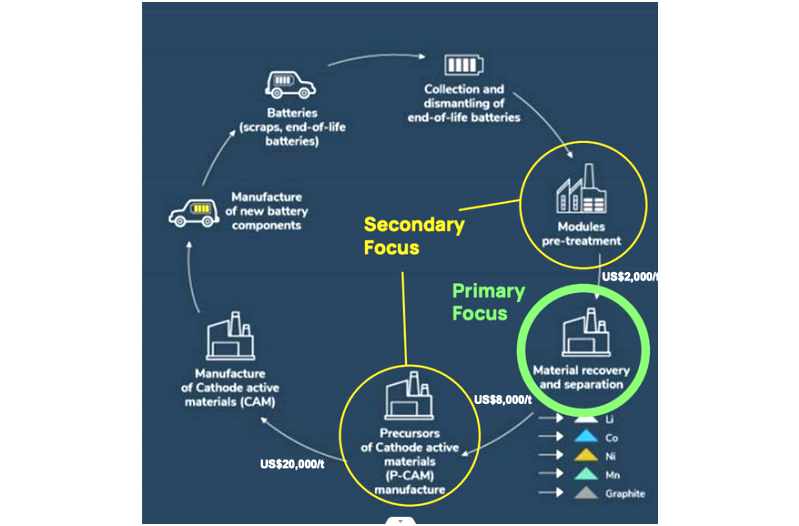
Battery recycling is a process of dismantling spent cells, and recovering their critical materials. The flammable electrolyte in lithium-ion batteries adds another challenge, in the form of high temperatures and corrosive acids. A new emerging company in Australia is exploring battery recycling using eutectic solvents as a cooler alternative.
Why the Interest in Eutectic Solvents for Battery Recycling?
Traditional battery recycling methods use high temperatures and corrosive acids. This method may well be successful, but the process is not environmentally friendly, and also consumes large amounts of energy.
Eutectic solvents, on the other hand are able to dissolve in each other, and melt and freeze at lower points. However, they have one particularly interesting characteristic. If we blend two eutectic materials together, then those melting and freezing points are lower than either of them individually, or a mixture thereof.
The Iondrive company in South Australia has just reported the successful completion of trial battery recycling using eutectic solvents. They say their ‘deep eutectic solution’ is a mixture of two materials that work together to dissolve specific metal oxides in spent batteries.
This option potentially allows Iondrive to onward sell its extracted lithium, cobalt, nickel and manganese metals. This is great news as we hear of lithium-ion battery recycling setbacks elsewhere, while global warming begins to influence our weather patterns.
Moving On From Inefficient, Hazardous, And Costly Recycling
Iondrive describes recycling lithium-ion batteries as ‘currently extremely inefficient, hazardous, and costly’. Most recycling is accomplished through incineration at extreme temperatures it continues, or through corrosion with powerful and toxic acids.
Therefore, they hope their hydrometallurgical battery recycling project will lead to a better outcome. This new initiative appears to offer an opportunity to more completely recover materials from spent batteries. It may also eliminate the need for multiple refining stages, and that would be a good thing too.
More Information
Novel Battery Material Recycling Using Heat