After a half-decade of reports and rumors, the news is finally out. CATL is delivering sodium-ion batteries come September this year, marking a significant moment in the history of batteries.
We unpack why this is a significant moment, not just for CATL but for the entire world. Lithium-ion batteries arrived forty years ago, and have commanded the market for the past decade.
Significance of CATL’s Sodium-Ion Break Through
The history of batteries comprises significant periods of stagnation, punctuated by dramatic leaps forward. Nothing much has changed on a macro-scale since lithium metal began dominating the market two decades ago.
Lithium metal has been highly successful in batteries. Battery producers have tolerated its instability, to satisfy consumer demand for higher and higher-performance, but that is changing as we write.
CATL is one of the biggest producers of lithium-ion batteries in the world. They are quietly saying, wait a moment, battery performance is not the only factor. We also need to think about safety, cost, and our fragile environment.
So here we stand at the doorstep of the next stage in the evolution of batteries. Car News China envisages CATL delivering gigawatt-hour-quantities of sodium-ion batteries this year, for energy storage and electric passenger vehicles.
Technology in Sodium-Ion Batteries
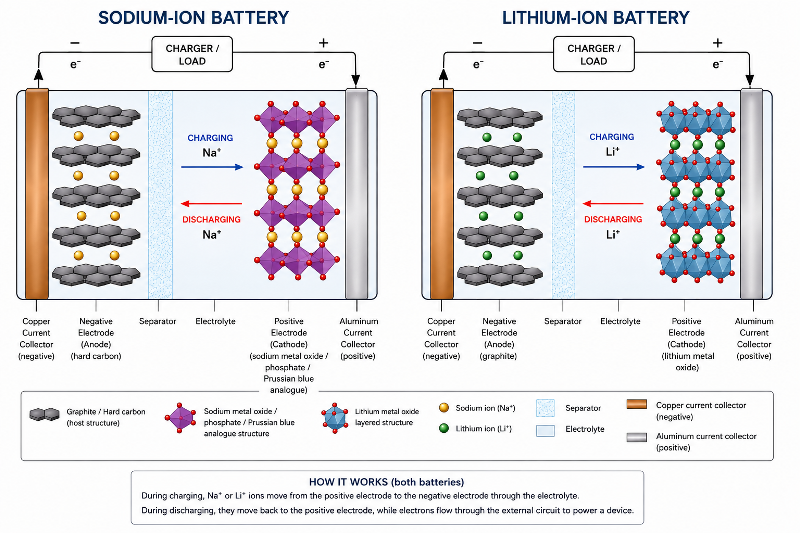
Lithium-ion and sodium-ion batteries share the same basic design and operating principles. Both use positive and negative electrodes, an electrolyte, and a separator.
Especially importantly, both rely on intercalation, where ions move between electrodes during charging and discharging. Both chemistries also offer high efficiency, rechargeability and long service life.
The main discriminator is the different ions they derive from their different metals. This makes it easier for CATL to start delivering sodium-Ion batteries. They just needed to switch from lithium ions to sodium ions, and make a few other adjustments.
More Information
Could Sodium-Ion Rival Lithium-Ion?