Converting raw energy into spinning motion powers land, air and ocean transport. We need electric motors to achieve this, while reversing global warming. Today we discuss magnetic forces behind the phenomenon, and illustrate this in action with an easy AA battery spinner experiment.
Materials for an Easy AA Battery Spinner Experiment
You will need the following materials, which you could source from any DIY or hardware store:
- A suitable length of bare copper wire, clean and ideally new.
- One AA-size battery, ideally rechargeable and with full charge.
- Between four and six shiny flat neodymium magnets.
- A small pair of electric wire side cutters to trim the wire.
Now Assemble the Test Bed for Your Experiment
Take up the battery between the fingers of one hand. Use the other to wrap the copper wire four times round it in a spiral. Wrap the end of the wire closest to the positive terminal around that lug, to hold it there.
Now gently stretch the other end of the coil so it reaches the negative terminal of the battery. Trim it with the side cutters leaving a small length to spare. Slide the copper wire coil gently off the battery and set it aside.
Next, place the flat end of the AA battery on top of the stacked neodymium magnets. Then slide the copper wire coil back over the battery until it ‘captures’ the positive terminal. Rearrange the other end of the coil so it lightly contacts the magnets. As you do so the coil will begin to rotate.
The Science Behind This AA Battery Experiment
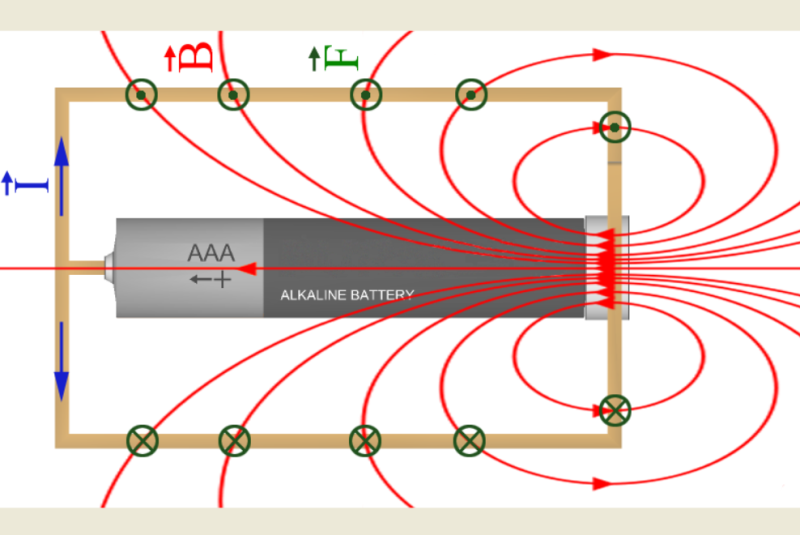
A phenomenon we call the Lorenz Force is behind the homopolar motor in this experiment. This theory holds that a conductor with a current flowing through, and placed in a magnetic field will rotate. This rotation will be in the direction perpendicular to both the magnetic field, and the current, and that’s what worked this time.
More Information
Build a Battery-Power Electric Train
Build a Battery With a Can of Soda
Preview Image: Dynamics of Homopolar Motor