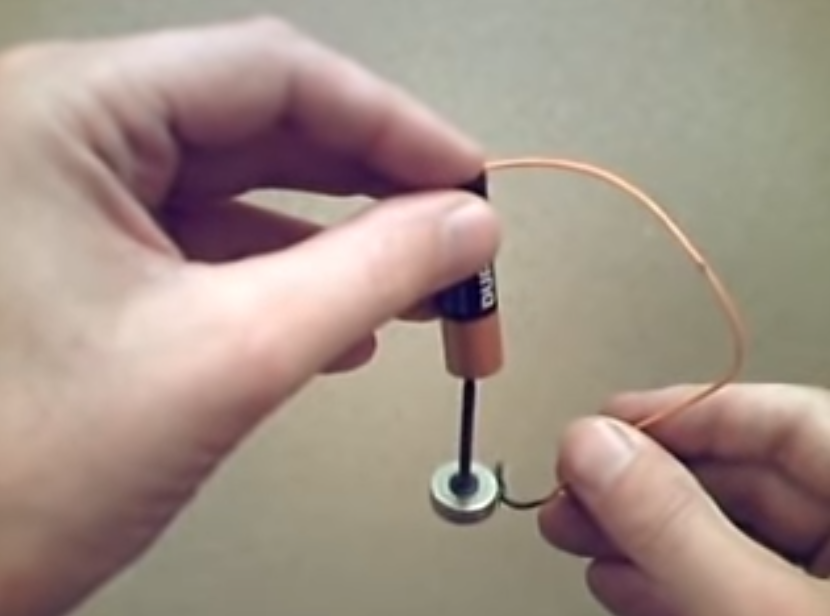
A homopolar electric motor uses direct current between two opposing magnetic poles. We build such a motor in this experiment using a battery cell, a drywall screw, a length of wire, and a rare earth battery. However you don’t have to stress about this experiment being expensive. That’s because ‘rare earth’ metals are common, although we don’t find them in seams for easy mining.
Building a Homopolar Motor Using a Neodymium Magnet

Neodymium is a chemical element with symbol Nd and atomic number 60. The hard, silvery metal becomes one of the most powerful magnets we know after we combine it with iron and boron. However, manufacturers plate the compound with common metal because neodymium is brittle.
Then we can safely use the magnets in headphones, loudspeakers and computer hard drives. We can also build a homopolar motor using a neodymium magnet capable of lifting a thousand times its own weight. This makes it a perfect counterbalance for the rotor of our motor. We just need to connect the battery, drywall screw, magnet and wire together.
Now Watch This Video Before You Make Your Motor
The Science Working in Your Homopolar Motor
The dry wall screw is the conductor through which the battery current flows perpendicularly. The magnetic field produces a torque around the axis of rotation eliminating the need for a commutator.

If we turned the screw mechanically, it would operate as a homopolar generator. This would then produce a direct current voltage between the two terminals of the conductor. Rare earths, as we have mentioned are not scarce resources. We find them sparsely distributed in various places. However, China has the most resources, and it has recently imposed export restrictions.
Hence western scientists are busily occupied researching ways to make strong magnets that do not require any of these rare earth metals.
Related
How to Make a Simple Electric Motor
Magnetic Levitation: School Experiment
Preview Image: Homopolar Motor Using a Rare Earth Magnet
Video Share Link: https://youtu.be/py-0dVJ4K_s