Galvani’s and Volta’s work gave batteries a great start. Alessandro Volta showed that electricity could be produced by a battery. The next challenge was finding a way to produce electricity without chemicals running out. Then Faraday alters everything with ‘magnetic electricity’.
A Man From a Poor English Family Alters Our World
The answer to continuous electricity came from Michael Faraday. He was born into a poor family in England in 1791. And so he received very little formal education and began work as a bookbinder’s apprentice. While binding science books, Faraday read them and discovered many scientific truths.
Faraday Changes Our World By Moving a Simple Magnet
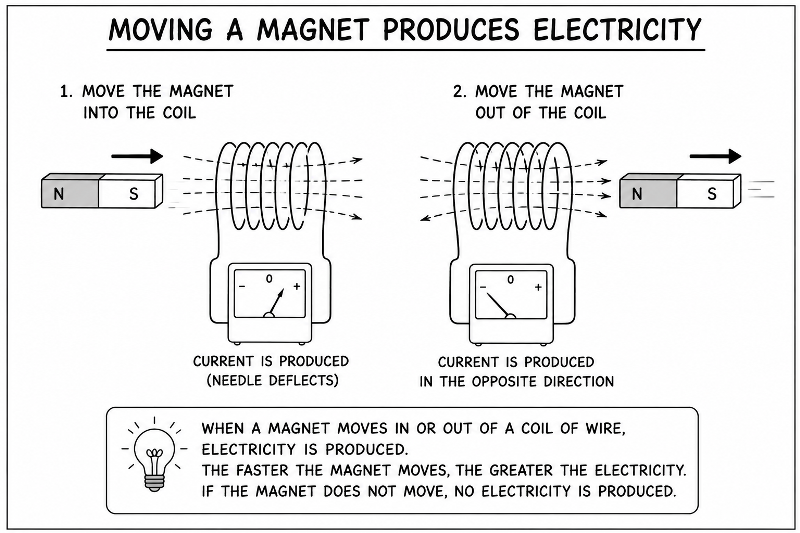
Faraday’s natural curiosity eventually earned him a job in a laboratory, where he made a discovery that changed the world in 1831. He found that that moving a magnet near a coil of wire produced electricity. However, this electricity stopped flowing when Faraday stopped moving the magnet.
This Discovery Opens The Door To Continuous Electricity
Faraday’s simple experiment revealed an important principle. Moving magnets can generate endless electricity. This discovery led to the invention of electric generators.
In this way, Faraday alters everything with electricity almost single-handedly. Instead of relying only on batteries, people could now produce electricity continuously.
Steam engines, flowing water, wind, anything that created movement, and, much later, nuclear energy would do the trick.
We Have Faraday To Thank For Our Power Stations
Almost every power station today still works on Faraday’s basic discovery. The machines may be much larger and more efficient, but the principle remains the same.
Faraday never became wealthy, but he went on to become one of history’s greatest scientists. In fact, his discoveries helped create the electrical world in which we live today.
Come Back For The Next Article About Managing Electricity
Come back soon for our next article. Share with us as we discover how to manage electricity safely and efficiently with batteries.
More Information From Our Battery Blog