Batteries are an essential aspect of our lives. We could not have our phones, renewables, and so on without them. Faster solid battery charging further improves their usefulness, although this often comes at the cost of shorter battery life. Researchers at KAIST University, South Korea, have uncovered a low-cost way for solid lithium-ion batteries to perform better.
Low Cost Path to Fast Solid Battery Charging
Solid state batteries are attracting increasing interest, even though they don’t fully meet our criteria for performance, cost, and safety. The KAIST discovery improves solid state battery performance, without adding expensive metals.
The key is to improve battery design instead of tweaking materials. The result is higher performance with lower risk of fire and explosion. We’d rather see no risk at all, but at least they are making progress …
- Ions in conventional batteries flow easily through liquid electrolytes.
- While solid electrolytes may obstruct the flow, requiring costly solutions.
- The researchers experimented with ‘divalent anions’ to try to avoid this.
Anions are atoms or molecules that have gained one or more electrons, and have a net negative charge. Divalent anions (such as oxygen or sulfur) have two charges. They gives them advanced chemical power, because one divalent anion can offset two regular ones.
New Technology to Control Internal Battery Structure
The KAIST study into faster solid battery charging, applied to low-cost zirconium-based halide solid electrolytes,with divalent anions. The scientists created a ‘framework regulation mechanism’ that widened pathways for lithium ions, and lowered energy barriers while they shuttled between electrodes.
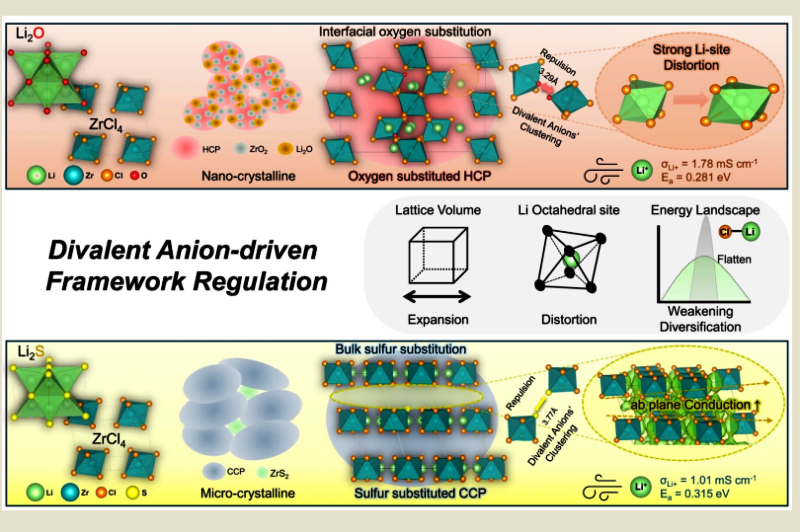
The results were quite remarkable. Electrolytes with added oxygen or sulfur, improved ion mobility by a factor of two to four. This demonstrated the possibility of improving solid battery performance, including faster charging, using inexpensive materials.
Lead author Jae-Seung Kim remarks how this study “shifts the focus from what materials to use, to how to design them” in the development of battery materials. “The potential for industrial application is very high,” observes study lead Professor Dong-Hwa Seo.
More Information
The Movement of Cations and Anions
Hidden Pathways in Lithium Batteries
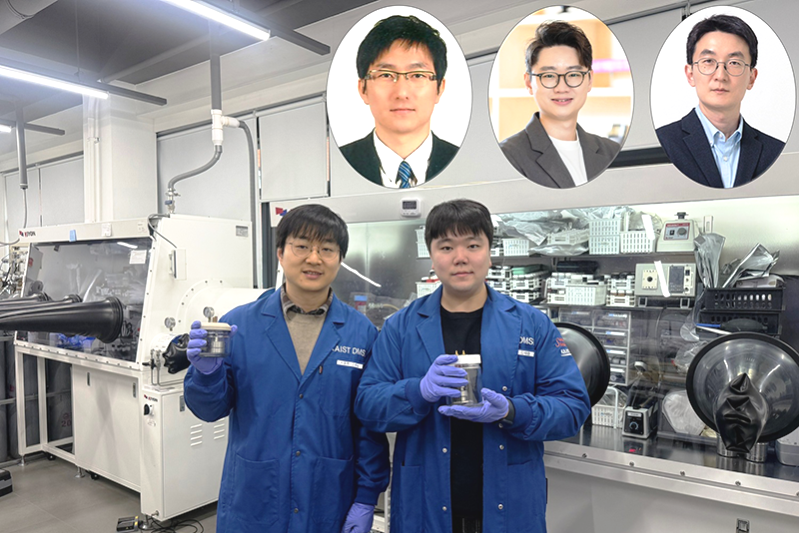
Preview Image: Researchers at KAIST