

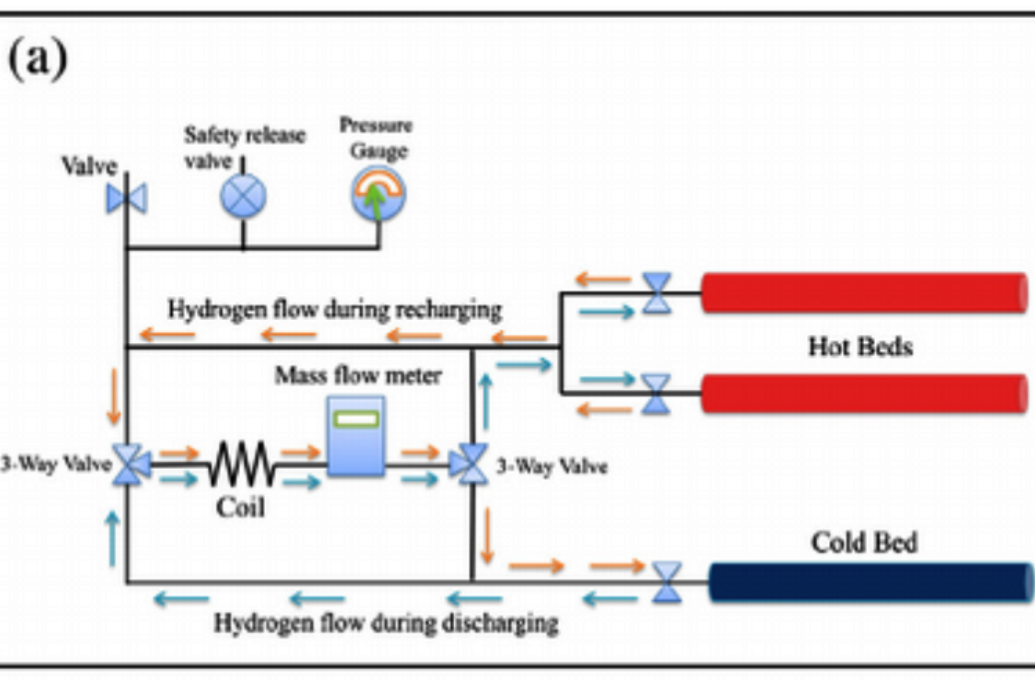
HRL Laboratories and the University of Utah demonstrated a high-density thermal battery using thermal hydrides. They hoped this would provide an energy-efficient electric car cabin-cooling system, freeing the main batteries to power the vehicle. Because thermal batteries store thermal energy, not ions at the atomic level of matter. This can involve creating cold from heat, or heat from cold via a heat exchanger depending on the application.
How Their High-Density Thermal Battery Functioned
Furthermore, this study is important despite successfully ending three years ago. This is because thermal energy storage remains one of the most promising technologies for utilizing solar and industrial heat. Thermo-chemical technology is proving one of the most successful options.
Thus, the high-density thermal battery using metal hydrides could prove to be a game changer. Since many metal alloys can combine with hydrogen to form metal hydrides. The team at University of Utah used two different hydrides on opposite sides of the process. The high-temperature one released heat when it absorbed hydrogen. While the low-temperature node cooled it as it released hydrogen. Through this process, they created a new thermal battery.
Thermal Battery Laboratory-Scale Demonstration
Cooling & Heating, and Selecting Hydride Materials
Heat is applied to the high-temperature side at the beginning of the recharging cycle, causing it to absorb hydrogen. Then hydrogen gas takes the thermal energy to the cool side, where it releases with a cooling effect.
The hydride material at the far side of the process must have complimentary thermodynamic properties for the system to work. Both must also function between the desired temperature ranges. The researchers used catalyzed magnesium hydride MgH2 as the high-temperature material. And various low-temperature ones including lanthanum compounded with nickel in their high-density thermal battery.
They reported their concept-demonstration-unit ‘showed both high heating / cooling power and high energy densities’.
Thermal and Thermochemical Conversion of Biomass into Energy
Geothermal Energy Makes Its Mark
Preview Image: Schematic of Thermal Battery Prototype
Video Share Link: https://youtu.be/C9Tssi526r8


