Parts of Europe are almost overwhelmed by a severe heatwave. Wildfires are burning. Some seem almost beyond human control and communities are evacuating. But is the European heatwave global warming? U.S. has experienced similar large fire events recently. We investigated and uncovered the basic facts
Did Global Warming Cause the European Heatwave?
Wikipedia confirms four weather events combined to create the deadly temperature rise:
- First, high pressures generated atmospheric stability leading to an accumulation of air pollutants.
- Then, remnants of tropical Storm Alex assailed northern United Kingdom with gale-force winds.
- Meanwhile, strong sunshine during the boreal summer caused high temperatures and natural warming.
- Finally, a warm air mass arrived from North Africa via Iberian Peninsula, loaded with suspended dust.
Climate scientists believe climate change is behind the exceptional heat. They expect associated changes in the jet stream will cause increasingly frequent heat waves in Europe. Research has previously shown how global warming makes boreal summers more persistent (see link below)

Extreme Heat Has Direct Impacts on Human Health (NASA)
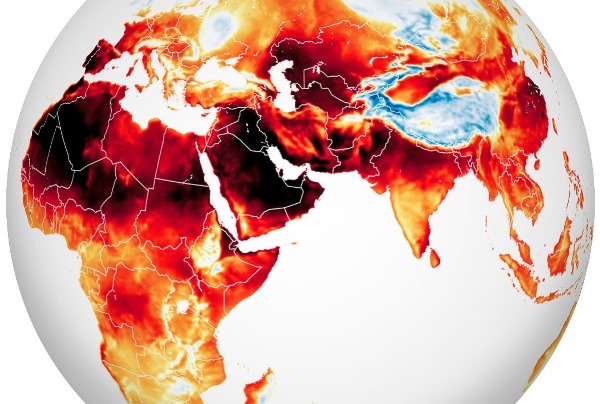
NASA (see link below) confirms heatwaves struck Europe, North Africa, the Middle East, and Asia during June and July 2022. Temperatures climbed above 40 degrees Celsius (104 degrees Fahrenheit) in places and broke many long-standing records. Their map above illustrates surface air temperatures across most of the Eastern hemisphere on July 13, 2022.
“While there is a clear pattern of an ‘atmospheric wave’ with alternating warm (redder) and cool (bluer) values in different locations,” they explain. “This large area of extreme and record breaking heat is another clear indicator. It is further evidence emissions of greenhouse gases by human activity are causing weather extremes that impact our living conditions.”
Breaking News
Disposable Vape Recycling Becoming An Issue
Adding Batteries at Coal-Fired Generators
Preview Image: Eastern Hemisphere Surface Air Temperatures