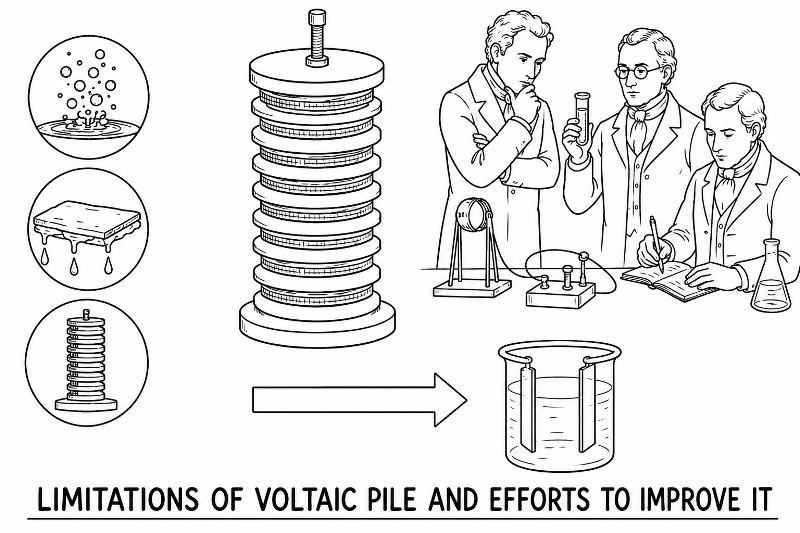
Alessandro Volta’s voltaic pile, introduced in 1800, was the first device capable of supplying a continuous electric current. It was a remarkable achievement, but the limitations of the voltaic pile made it less than ideal.
Weaknesses Urged Scientists To Search For Better Ways
Those weaknesses encouraged scientists to search for better ways to produce and manage electricity. Volta’s pile consisted of alternating discs of two different metals, usually zinc and copper.
Pieces of cloth or cardboard soaked in a salt solution separated the two metals. Stacking more layers increased the voltage, but this did not resolve the underlying limitations of the voltaic pile.
Polarization Made Hydrogen Gas Form On One Surface
Polarization was a major weakness. Hydrogen gas formed on one of the metal surfaces during operation. The bubbles gradually covered the surface and interfered with the chemical reaction. As a result, the current weakened and eventually became unreliable.
The Electrolyte Also Created Practical Challenges
The electrolyte also created practical difficulties. The salt solution could dry out. The liquid sometimes leaked from between the metal discs. The pile could therefore become messy, and inconvenient to use. Increasing its size made it more powerful, but also made it less practical.
There Was a Wider Social Reason For Improving Batteries
There was also a wider social reason for improving batteries. Electricity was becoming an important subject of scientific research during the early nineteenth century.
Researchers needed dependable sources of current for experiments involving chemistry, magnetism, and the newly discovered relationship between electricity and other natural forces.
The Voltaic Pile Opened The Door For a Better Solution
The voltaic pile had opened the door, but scientists soon realized they needed a more stable source of electricity. Inventors began experimenting with different metals, electrolytes and cell arrangements.
Their work gradually moved battery technology away from simple stacks of discs, towards individual electrochemical cells. One of the most important of these, was the Daniell cell, which greatly reduced the problem of polarization.
More Information From Our Battery Blog