Design News revealed on 5 November 2018 that lithium dendrites develop in different ways. That’s because the ‘spiky dendritic crystals’ on the lithium metal foil anode respond differently according to the charging rate. This may not be good news for smartphone and electric vehicle owners.
How Lithium Dendrites Disrupt Lithium Battery Lives

Lithium batteries initially inhibit dendrites by using layered carbon anodes. Thus, these are able to store lithium ions between the carbon atoms in a process scientists call intercalation.
However, and that’s the catch, the graphite anode can only accommodate so many of these lithium ions. This directly affects the amount of energy the battery can store.
When the graphite anode becomes saturated, the surplus lithium ions accumulate on the metal foil surface forming lithium dendrites. These can grow large enough to penetrate the separator, reach the cathode, short-circuit the electrodes, and generate sufficient heat to cause a fire.
How the Amount of Charging Current Influences This
The research team at Washington University in St Louis has been able to map the lithium dendrites personalities. They report these grow into ‘tree-like structures’ when charging under high current, for example when fast charging EV batteries.

Whereas ‘below a certain threshold of current’ the ‘dendrite whiskers’ grow directly on the metal surface and there are no ‘tree trunks’. Between these two limits the ions plate the foil ‘in a variety of shapes’. This relates to ‘the competing reactions in the region between the liquid electrolyte and the metal deposits’.
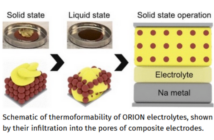
This new information may affect the rollout of electric vehicles where a fast charging capability is the deciding factor. However Design News hopes solid electrolytes may prevent the danger of lithium dendrites short circuits to an extent.
The research team believes a nano-porous ceramic separator could block dendritic whisker growth up to a certain current density. After that, unfortunately, the dendrites trees would penetrate the separator with predictable results.
Related
Rice University Team Quenches Dendrites
Cryo-Electron Microscopy Spies on Dendrites
Preview Image: Forms of Lithium Dendrites