What happens deep down inside lithium-ion batteries has continued to be something of a mystery. We have never fully understood what causes the expansion and deterioration of the anode material as the lithium ions flow. But now, scientists at Korea Institute of Science and Technology have been able to observe lithium-ion battery degradation directly.
Observing the Lithium-Ion Battery Degradation Pathway
Mining.Com, where we stumbled over this news explains it is common knowledge changes occur in the internal electrode materials. However, we have until now been unable to directly observe what happens during the charging and discharging cycle.
This is because this occurs inside the battery case. And when we open that, fresh air instantly contaminates the electrolyte and electrodes inside. But the Korean researchers developed a workaround using a battery analysis platform they designed themselves.
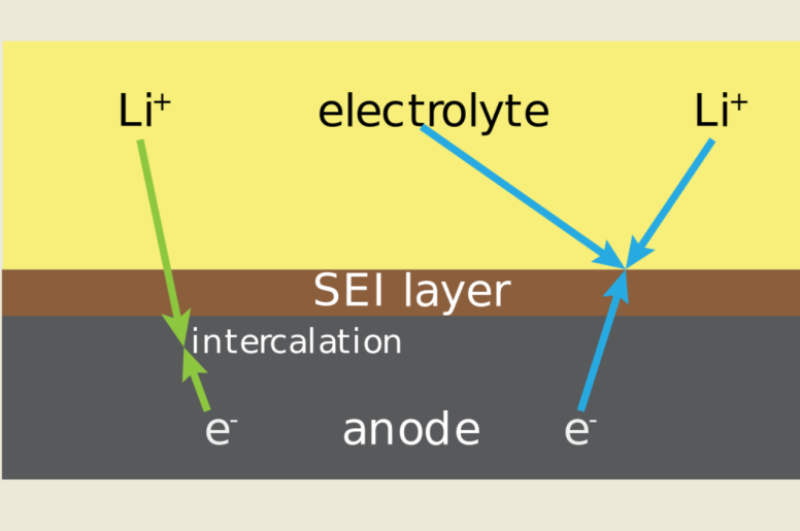
They were able to actually observe the migration of lithium ions into a silicon–graphite composite anode. And they noted that lithium ions migrate sequentially into the carbon, nanopores, and then silicon in the silicon-graphite composite.
What This Means for Silicon-Graphite Anodes
The Korean researchers’ explanation for lithium-ion battery degradation is a world’s first achievement. They were studying silicon–graphite composite anodes, which have ten times greater capacity than conventional graphite ones. But the former expand four times by size during the charging process, and this makes them unstable.
Other scientists had previously theorized that nanopores formed during recharging, causing the anodes to expand. However, this new finding is the first to visually confirm that this is actually happening. The Korean team suggests the novel approach of distributing micro and nano-sized pores, to alleviate the volume expansion of the silicon in future.
Jae-Pyoung Ah is head of Korea Institute of Science and Technology Research Resources Division. He wrote in a media statement. “Just as the James Webb Space Telescope heralds a new era in space exploration. So also our analysis platform opens new horizons in material research, by enabling the observation of structural changes in electric batteries.”
Breaking News
Recycling Lithium-Ion Batteries With CO2
LiFePO4 Batteries Are Set to Take a Lead