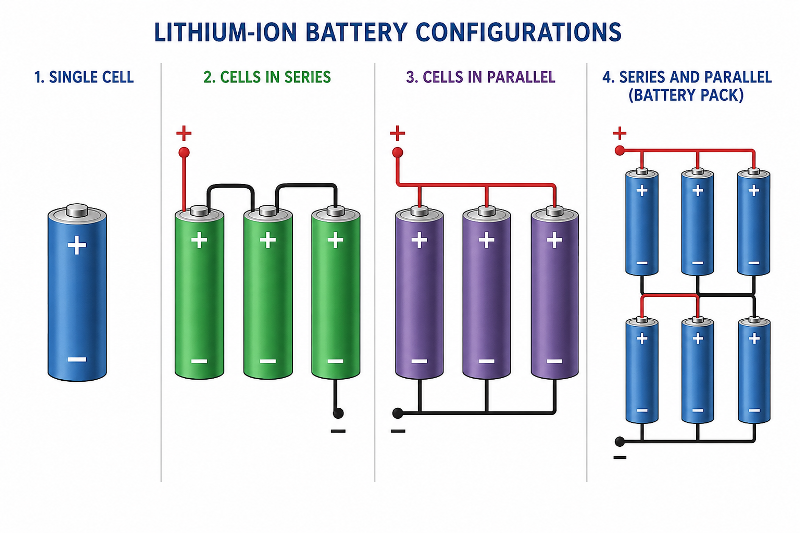
Lithium-ion cells and batteries have become the force behind electric transport. A single lithium-ion cell is the basic energy storage unit. A battery is one or more cells connected together to produce the required voltage, capacity, or both.
Any lithium-ion battery configuration could cause a fire. Although the chances of this happening are statistically low, they do still happen.
Lithium-Ion Single Cells Are The Basic Building Blocks
Single-cell batteries are the simplest units in the hierarchy. We find them in smartphones, blue tooth headphones, and small sensors to mention a few. Single cells are compact, easy to manage, and have the lowest risk of a fire spreading, because only one cell is involved.
Connecting Cells In Series Increases Total Voltage
Connecting cells in series in lithium-ion cells and batteries increases the voltage, while the capacity to store energy remains the same. Power tools, electric bicycles, and electric vehicles use many cells in series to achieve higher operating voltages.
These batteries require sophisticated battery management systems to keep every cell balanced, and prevent overcharging or deep discharging.
Connecting Cells In Parallel Increases Total Capacity
Connecting cells in parallel keeps the voltage the same, but increases the battery’s capacity and output current . This arrangement is common in power banks, and larger energy-storage systems where longer operating times are essential.
Combining Series and Parallel Links In Large Batteries
Large batteries usually combine both series and parallel connections. For example, an electric vehicle battery may contain hundreds or thousands of cells, arranged into modules and packs. Combining lithium-ion cells and batteries is the only way to store renewable energy.
Does Configuring Cells and Batteries Affect Safety?
Thermal runaway becomes more serious as battery size increases. In a single cell, overheating is usually confined to that cell. In a multi-cell battery, heat from one failing cell can spread to neighboring ones, causing thermal spread.
This is why larger lithium-ion batteries should include cooling systems, fire-resistant barriers, cell spacing, sensors, and battery management systems. These should detect faults early, and can reduce the likelihood of thermal runaway spreading beyond the original cell.
More Information