Researchers at the School of Materials and Energy, Southwest University, China, noted that people love playing in oceans and estuaries. And so they took a second look at traditional batteries, and marveled how incompatible these two phenomena were. They decided to develop alternative net or fabric seawater batteries instead, that could flow with the waves.
Weaving Flexible Net And Fabric Seawater Batteries
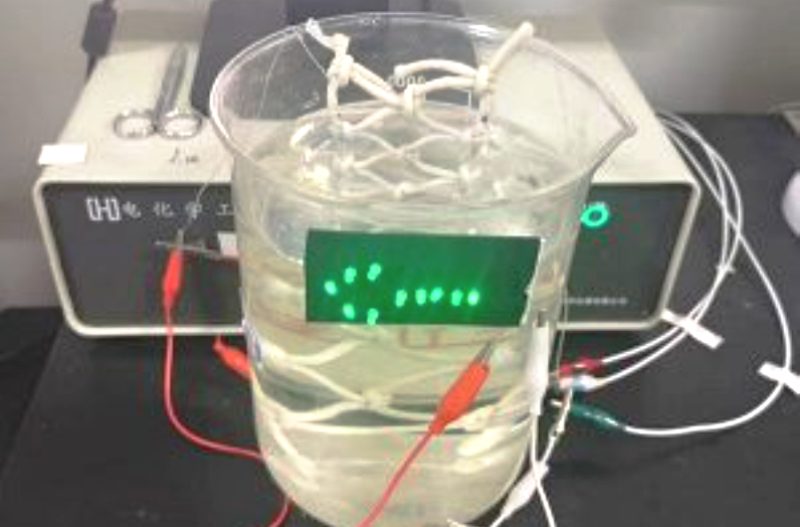
The School of Materials and Energy team first created a ‘yarn-like battery prototype’, that worked when immersed in seawater. And then they knotted the rechargeable strands into a fishing net that illuminated LEDs, before they wove a fabric that also powered a timer.
At first they wondered how to protect their new battery from seawater. But then they thought, why not use the salty water as the electrolyte instead of trying to keep it away.
The team had some related experience in these matters, having previously developed a battery comprising carbon fiber and cotton yarn. Except that previously, they used human body perspiration as their electrolyte, for powering exercise monitors in a gymnasium.

Seawater And Sweat Contain Sodium, Chloride And Sulfate Ions
The team knew that seawater and perspiration contain sodium, chloride and sulfate ions. And so they set to work to create a prototype of their idea, having established that their yarn-like battery could power lights on fishing nets, life jackets, or mooring lines for buoys.
They began by coating carbon fiber bundles with electrically conductive materials, to form the electrodes. For these coatings, they chose nickel hexacyanoferrate for the positive cathode bundle, and polyamide for the negative anode.
Next, the team twisted their carbon fiber bundles to form cathode and anode strings. Then they wrapped the cathode in fiberglass, and laid it side-by-side with the anode inside a non-woven, permeable fabric. This material protected the electrodes, while allowing the salt water to enter, and become the electrolyte.

More Information
Salt Water Battery Technology Leaps Forward
Solar Power Plant with a Giant Salt Battery in Andalusia
Preview Image: Rechargeable Strands Light LEDs