Researchers are working on electric cars that can travel short distances and find the next charging station, all without a driver.
On the basis of cost-effective sensors, they are developing a dynamic model that perceives the environmental situation.
It is truly amazing how far automobile technology has evolved in just the past 20 years alone. Electronic helpers warn of a possible collision when parking and keep the necessary distance to the car ahead, while in traffic.
There are lane departure, crosswind, blind spot and high beam assistants, not to mention the anti-lock braking system. The car is making major progress in taking the decision making away from the driver and effectively handling these tasks on its own.
Now, researchers at the Fraunhofer Institute for Manufacturing Engineering and Automation IPA are taking this driverless idea to a completely new level. They are dedicated to automated driving and are working on the vehicles of tomorrow. These vehicles of tomorrow will be able to maneuver through traffic without human assistance.
The researchers at the IPA are known for their development of robots, with that in mind creating a driverless car isn’t too big of a difference. Sensors are needed to recognize the environment so the vehicle can navigate around obstacles to wind up at its destination.
This idea started a year and a half ago, when a team of computer scientists, mathematicians, electrical engineers and mechatronics engineers launched the project to create a driverless electric vehicle.
One of the main thoughts was that, in the case of car-sharing, the car should be able to be parked in a designated spot and then recharge itself to be ready for the next driver. The team of researchers designed the car so that it communicates via a wirelesss interface with the charging station and the parking garage management.
This will allow the vehicle to provide information about its charge level and its location. If the battery is low and a charging station is available, the car will then maneuver in the corresponding parking bay and charge itself, without a cable. When the car is charged it can move to a designated area, to make room for the next vehicle.
“The technology needed for this scenario is already available,” says Afkar project manager Benjamin Maidel. Maidel is referring to the robots of the institute that find their way easily in a known environment, such as a factory floor. Building a vehicle with the same ability isn’t much different.
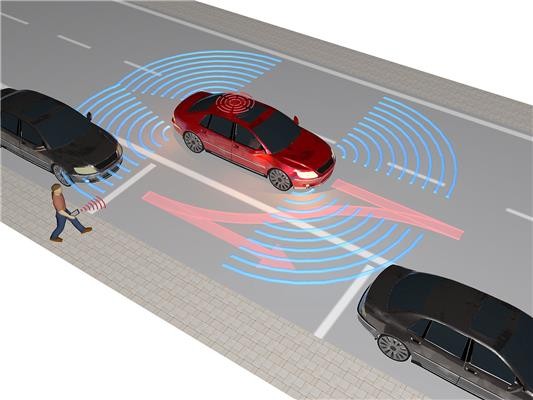
Many of the newer cars already have most of the sensors that are required to do this. The data that these devices collect just need to be combined and interpreted accordingly so that they provide a picture of their environment. The Fraunhofer technicians are currently working on developing the necessary technology with the help of complex simulation programs.
The more difficult task is developing a vehicle that can autonomously maneuver in traffic. This requires sensors that can see hundreds of meters ahead, as well as software that can react to any unforeseen events, whether that’s a building site, a thunderstorm or even adverse driving situations. Maidel and his team are focusing on cameras, ultrasound, radar and even laser scanners that perceive the surrounding area up to a distance of 200 to 300 meters.
“Whether autonomous driving makes a breakthrough will be decided, along with the right price, by customer acceptance and the legal framework. For example, the liability for accidents has to be re-regulated. The technology will probably conquer the market step by step,” says Maidel.
The advantages are obvious, especially for car-sharing vehicles. Any customer could use their smart phone to call a car, which would then drive to the desired location.
At UPS Battery Center, our goal isn’t to only sell batteries, we want to inform and teach you about the amazing world of batteries, electricity and energy. Please check back for more interesting, helpful and informative articles about batteries and electricity.
Related Articles:
Electric Cars Do Not Pose Elevated Risk of Cancer from Electromagnetic Fields, Experts Say
Energy Efficiency: Electric Cars
Nanomaterials to Improve Electric Vehicle Battery Technology
New Electric Car Battery Decay Caused by Heat
Researchers Develop Technology to Estimate Range of Electric Vehicles